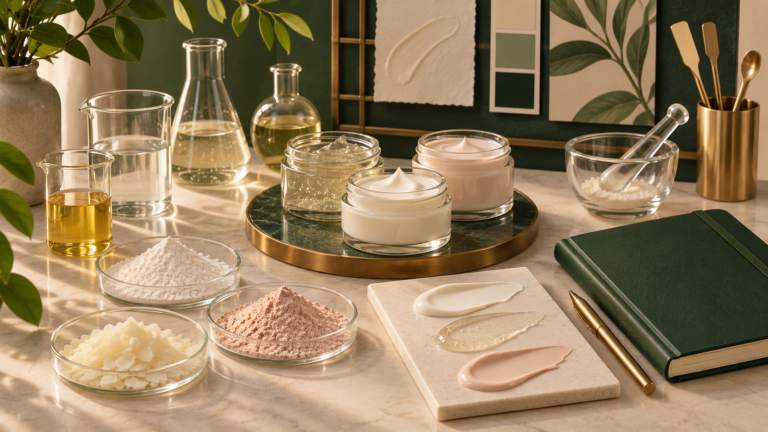
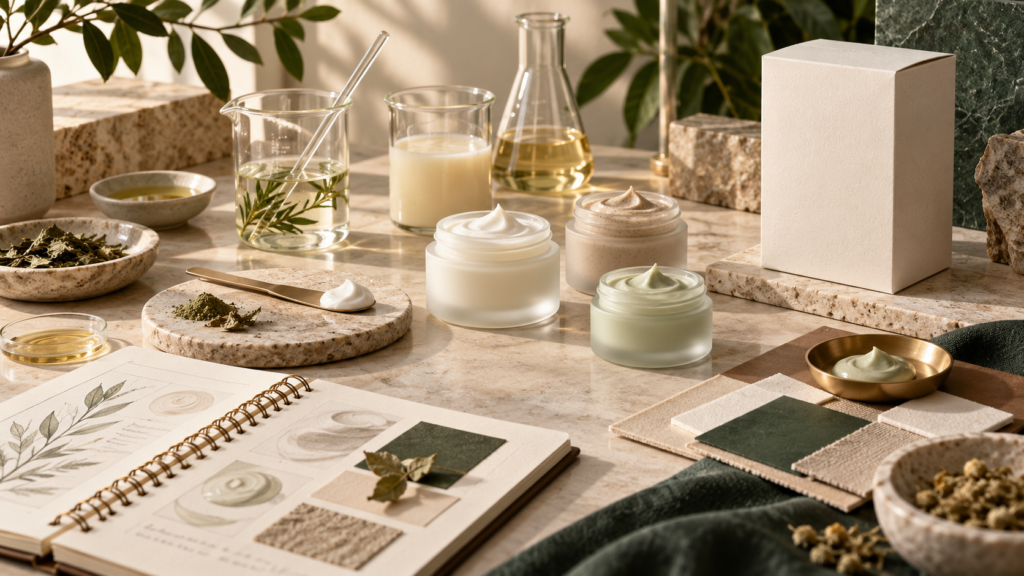
A cosmetic product development process turns a product idea into a specific formula that a team can evaluate, document, and hand over for the next stage. The work usually begins with a brief, continues through feasibility review and sample feedback, and includes a plan for safety, stability, packaging, and claims. It is iterative: an evaluation can lead the team back to the formula or the package before an agreed version is ready.
The most useful outcome is not simply a sample that feels good. It is an identified formula version, linked to a defined package and supported by an appropriate set of information, with remaining questions and responsibilities recorded. A formula approval is a development decision. It is not, by itself, a safety assessment, authorization to sell, or production release.
For a beauty brand, good development starts by making decisions visible. Who is the product for? How will it be used? Which market and claims are planned? What must the sample show, and what evidence will be needed later? Answering these questions early helps a brand and its development partner use each sample round to learn something useful.
The cosmetic product development process at a glance
The exact sequence depends on the product and market, but a practical process can be organized around six connected decisions:
- Brief: Define the product, user, intended use, target markets, priorities, and constraints.
- Feasibility: Review the starting point, technical questions, project roles, and information needed to proceed.
- Samples: Develop identified versions and compare them against the same criteria.
- Evaluation: Design an appropriate plan for the formula, intended package, claims, and use.
- Approval: Record which version is accepted, what the decision covers, and which work remains open.
- Handover: Transfer the agreed specifications, records, and change controls to the people responsible for later stages.
These are decision points, not necessarily separate blocks of time. A packaging review can begin while samples are being refined. A proposed claim can influence the first brief and may be revised when evidence becomes available. The people responsible for formulation, quality, packaging, marketing, and regulatory review need enough information to make their decisions at the right time.
Some work may continue after a preferred formula is selected. FDA explains that product testing is one part of establishing cosmetic safety and that the appropriate approach depends on the product and available information. [1] In the EU, the applicable framework includes a product safety report before a cosmetic product is placed on the market. [8] An attractive prototype does not replace those decisions.
Define a product brief that a development team can use
A useful brief describes what the product should do for the user and how the business expects to bring it to market. It does not need to prescribe a complete formula. It does need to give the development team enough context to ask the right technical and commercial questions.

Describe the user and intended use
Start with the product format and application: for example, a rinse-off cleanser, a leave-on body lotion, or a hair oil. Explain where and how the product is intended to be used, how often the user may apply it, and whether an applicator is part of the experience. If the product is intended for a particular audience or area of the body, say so. These details can affect the information a qualified reviewer needs when assessing the product.
Describe the experience in concrete terms. “A light lotion that spreads easily and leaves a low-residue finish” gives a formulator more direction than “a premium lotion.” If fragrance matters, explain the intended character and intensity without assuming that a preference automatically fits the finished formula. If the team has a benchmark product, record what the benchmark is meant to illustrate: texture, dispensing, finish, fragrance, or another feature.
Identify markets and proposed claims
List confirmed destination markets and distinguish them from markets that are only under consideration. Give the team the intended label language, distribution channels, and any known retailer requirements. Market and channel decisions may affect the documents, labeling, claims review, and approvals needed later.
Write proposed claims as a list rather than placing them only in a mood board. Distinguish a product objective, such as a moisturizing skin feel, from a statement the brand intends to put on a label or website. In the United States, certain claims about treating disease or affecting body structure or function can affect whether a product is regulated as a drug. [6] The development team should review intended use and proposed claims early with the appropriate specialists.
Separate requirements, preferences, and unknowns
Make a short table with three columns. Requirements are necessary for the project to proceed. Preferences can be discussed if a technical or commercial constraint appears. Unknowns are questions the team must resolve. This simple distinction prevents an early idea from becoming an assumed specification.
Include any ingredient direction or exclusions, package preference, expected quantity, target cost, and desired launch window. Avoid treating an early target as a confirmed supplier commitment. Ask the people reviewing the brief to identify which requests depend on further testing, information, or feasibility work.
A concise brief might state: “Develop a leave-on body moisturizer for adult consumers in the named markets. The preferred format is a pump bottle. The product should spread easily and leave a low-residue feel. Fragrance direction and the final packaging material remain open.” The example is hypothetical. A real project needs its own use, claims, market, and safety review.
Translate the brief into a development plan
The next step is to agree on how the team will turn the brief into a sample. A project may begin with an existing formula direction, a proposed adjustment, or a new concept. It may also begin with information supplied by the brand. Whatever the starting point, ask for a description of the work required to evaluate it against the brief.
Assign one owner for each major decision. The brand may coordinate commercial requirements and consolidated feedback, while technical, quality, packaging, and regulatory specialists contribute their own reviews. The exact division depends on the contract and the people involved. The important point is to identify who can answer a question, who recommends a decision, and who is authorized to approve it.
Agree on the information the supplier needs and the conditions for sharing it. If the brand provides a confidential formula, benchmark analysis, customer research, or other sensitive material, confirm the confidentiality terms and use a suitable secure channel. Clarify whether third-party laboratories or packaging suppliers will receive information and what they need to perform their work.
Give every sample a unique reference. A practical record includes the project name, formula or sample identifier, preparation date, relevant packaging, intended purpose, and the person responsible for the record. The team should be able to connect feedback and test reports to the exact sample they describe. FDA's cosmetics GMP inspection checklist discusses the importance of written processing instructions, specifications, and records; the checklist is guidance, not proof that any particular supplier has those controls. [11]
Finally, establish decision gates. A gate can be simple: “Is this version suitable for a further sample?” or “Is the formula sufficiently defined to plan evaluation in the proposed package?” Record any assumptions and pending decisions. The plan should allow the team to revisit an earlier choice when a test, material availability, or market review provides new information.
Understand formulation choices and trade-offs
Buyers do not need to write a laboratory formula to take part in development. They do need to understand that ingredients perform different functions and that a change in one part of a formula can affect other properties. The development team selects and evaluates the combination for the particular product rather than treating ingredients as independent marketing features.
Depending on the format, a formula may include a water phase, oils or other emollients, materials that help phases remain mixed, a preservation system, fragrance, and other components. Not every product contains all of these. A water-free oil, a cleansing product, and an emulsion have different design questions. Ask the formulator what each major component contributes and which choices are most important to the brief.
Trade-offs often appear when the brand requests a change. A heavier emollient direction may alter the feel or appearance of a product. A fragrance change can affect the scent profile and may require the team to consider other properties of the finished combination. A pump, jar, or tube creates a different use experience and may change the questions the team asks about dispensing and exposure during use. These are reasons to evaluate the proposed product as a whole, not predictions about a particular formula.
Do not assume that a familiar ingredient, a natural origin, or an ingredient supplier's data establishes the safety or performance of the final product. FDA notes that natural ingredients are not automatically safe and that safety decisions depend on the relevant evidence. [1] An ingredient study may be useful background, but its conditions and conclusions must be assessed before using it to support a finished-product claim.
Ask the development team to explain the practical implications of each significant choice. Which aspect of the brief does it address? What information supports it? Does it affect the package, evaluation plan, or target claim? If the team proposes a substitute, ask what would need to be reviewed before accepting the change.
Make the first sample round useful
The first sample is an opportunity to test the brief and improve the next decision. Before opening it, confirm the sample ID, intended use, package, and any handling instructions supplied with it. Compare only samples that the team has identified and provided for that purpose. A sample's sensory appeal is useful feedback, but it is not a safety or performance conclusion.
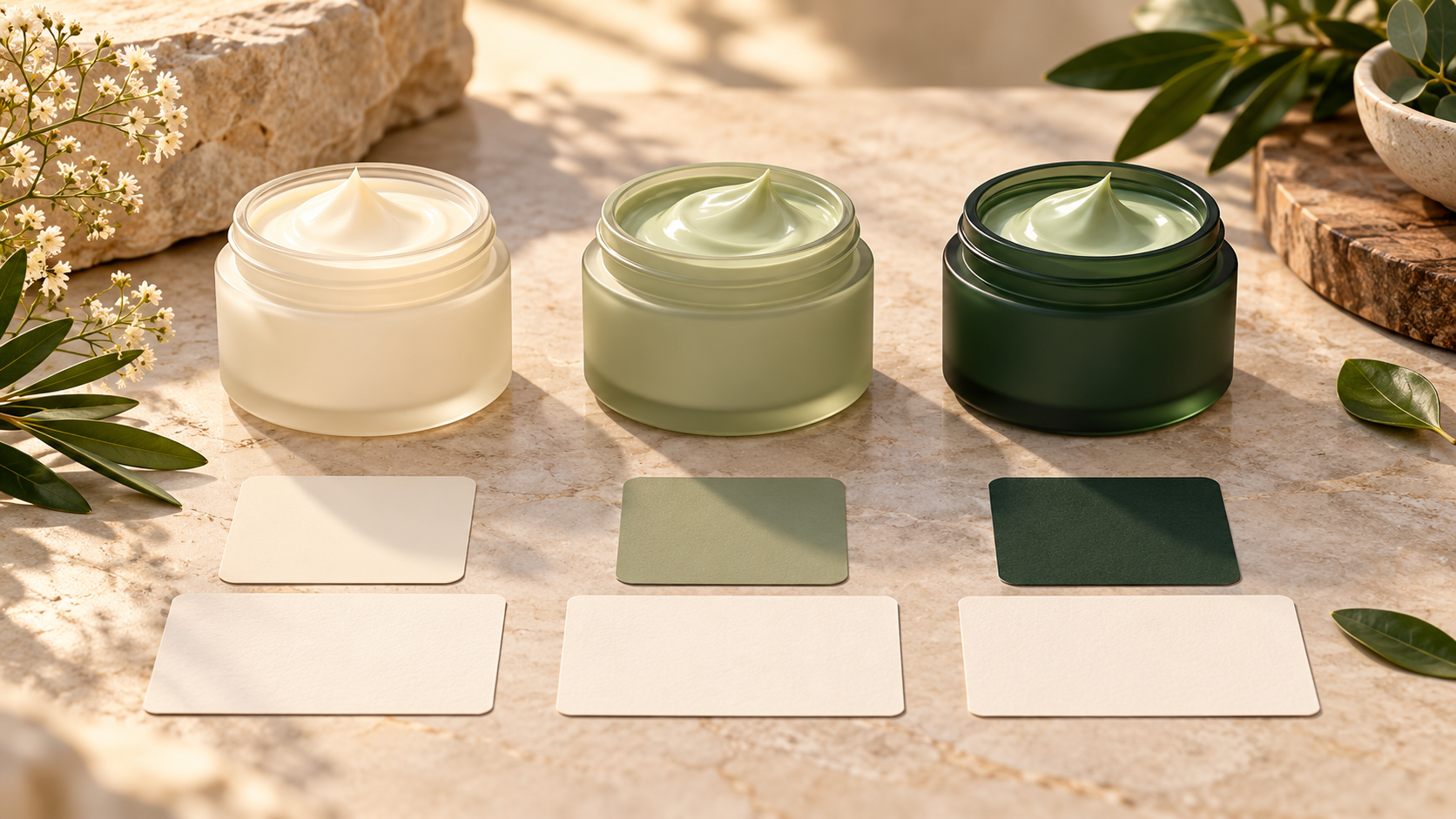
Use a consistent feedback form. Record appearance, fragrance, texture, ease of dispensing, spread, finish, and other characteristics relevant to the product. Describe observations rather than relying only on an overall score. For example, “the pump delivered too little product for the intended application” tells the development team more than “the package feels wrong.” If the formula and dispenser were both unfamiliar, note both rather than assuming which caused the observation.
Compare samples under reasonably consistent conditions. Record what was compared, the amount and application method used, and the criteria relevant to the brief. Do not claim that an informal sensory review is a clinical study or a validated product test. Where a project needs formal consumer, tolerance, or efficacy research, qualified professionals should design and interpret that work for the intended claim and product.
Consolidate feedback before sending it. If several reviewers have different preferences, identify which comments are shared, which conflict, and which are essential to the decision. Ask one person to assemble the response so the team does not receive incompatible instructions. List requests in priority order: what must change, what should remain, and what can be explored if feasible.
End each round with a clear decision. The brand might ask for a revised sample, request more information, stop a direction, or accept a version for further evaluation. Record the reason and the exact version. A useful feedback conversation makes it possible to explain later why the team moved from one version to the next.
Revise without losing version history
Development involves change, but a change should not erase the history of the product. For every revision, record what changed, why, who requested it, who approved it, and which new sample or specification carries the change. Link reports and observations to the version actually evaluated.
A simple version register might include the formula identifier, preparation date, material or process change, package used, associated reports, current status, and open questions. The register need not reveal confidential formulation details to every participant. It does need to let the people responsible for evaluation determine whether a report applies to the version they are reviewing.
When a formula, raw material, process, site, or package changes, ask a qualified person to assess the effect on existing evidence. The answer is not automatically “repeat every test,” nor is it automatically “nothing changes.” The decision depends on the change, the product, the purpose of the evidence, and the remaining risk. ISO's stability guidance describes the need to justify a protocol for the particular product and conditions, rather than applying a single universal assessment. [2]
For example, a brand may approve the feel of one lotion version and later request a different fragrance. The team should identify the new version and assess which earlier observations remain useful and what further work is appropriate. If a packaging supplier changes a component, the team should review the change against the intended formula and package function. Record the rationale and the people who accepted it.
Version control also helps prevent an approval from being applied too broadly. “Sample approved” is ambiguous if several samples are in circulation. “Sample B, in the specified pump bottle, accepted for sensory direction; stability review remains open” gives the next team a usable decision and its limit.
Build a risk-based evaluation plan
An evaluation plan connects a question to the information needed to answer it. It should be proportionate to the product's formula, intended use, package, claims, and market. A moisturizer, a rinse-off cleanser, and a product used around the eyes may require different considerations. The plan should be prepared and reviewed by people qualified for the relevant technical and regulatory decisions.
Start with the decision. Is the team trying to understand whether the product remains within agreed specifications during storage? Whether the preservation approach is appropriate for the microbiological risk? Whether a dispenser works with the product? Whether the evidence supports a proposed claim? Each question needs its own rationale and may call for a different method or type of information.
For each item, record:
- The objective and the decision it will support.
- The exact formula version, batch or sample, and package under review.
- The proposed method and conditions, selected by an appropriate expert.
- The properties to be observed and the criteria for interpretation.
- The person or organization conducting the work and the report owner.
- The expected decision point, dependencies, and procedure for unexpected results.
Different kinds of information serve different purposes. Raw-material specifications help describe what enters a formula. Existing scientific data may inform an assessment of an ingredient under relevant conditions. Finished-product testing can address selected questions about the product that was tested. A qualified safety assessment considers the relevant information together for the product and intended use. These categories should not be treated as interchangeable.
FDA states that it does not have a single list of tests required for every cosmetic product or ingredient; available information can be considered and further testing may be needed to address gaps. [1] That does not mean testing is optional in every case or that a supplier's standard panel is sufficient for every market. It means the appropriate plan requires judgment about the specific product and applicable obligations.
Ask for the final report, not just a statement that the product “passed testing.” The report should identify what was tested and what the result means within the method and conditions used. If the tested sample differs from the proposed final formula or package, ask the reviewer to document the relevance and any limitations. No test result should be invented or extended beyond what it supports.
Consider stability, microbiology, and packaging together
The formula and package are connected throughout development. A package protects and delivers the product, while storage and use can affect both the contents and the experience. Planning these topics together helps the team identify a change before it becomes a late-stage surprise.
Stability and shelf life
Stability evaluation asks whether a product remains within defined, relevant specifications under selected conditions. Depending on the product, observations may relate to appearance, odor, physical properties, packaging function, or other characteristics chosen by the technical team. The question is not simply whether a sample looks acceptable on the day it is made.
ISO/TR 18811 describes a framework for identifying suitable stability methods and states in its public abstract that one single approach cannot cover the variety of products, storage, and use conditions. [2] Its abstract does not prescribe a universal duration, temperature, pass threshold, or shelf life. A technical team should justify a protocol and interpret the result for the specific product. Consultation of the public summary is not a substitute for reviewing the complete standard when it is needed.
FDA explains that shelf life varies with product type, storage, and use. It notes that changes such as emulsion separation or loss of preservative effectiveness can occur over time. [5] Ask how the proposed shelf-life decision will be supported and which product, package, and conditions the evidence covers. Do not assign a shelf life solely because a similar-looking product carries one.
Microbiological risk and preservation
Cosmetics can be exposed to microorganisms through raw materials, water, manufacturing, packaging, storage, and use. FDA describes several possible routes of contamination and the importance of assessing microbiological safety. [4] The relevance of each route depends on the product and how it is made, packed, and used.
Discuss how the team will assess the product's microbiological risk and the suitability of its preservation approach. A preservation efficacy test is one possible part of an assessment; its appropriateness, method, and interpretation should be decided by qualified specialists. ISO 11930's public abstract describes preservation efficacy testing and microbiological risk assessment in the evaluation of antimicrobial protection, including a low-risk distinction. [3] It does not establish that every cosmetic requires the same test or that a single result proves complete product safety.
Ask which sample and package are covered by the assessment, how manufacturing controls relate to the product's design, and what the team will do if an unexpected result appears. A change to a raw material or package should be reviewed for its potential effect rather than assumed irrelevant. Record the technical rationale for the decision.
Packaging compatibility and use
The selected container and closure need to work with the formula and the intended user experience. Ask the packaging and technical teams to review component identity, contact materials, fit, sealing, dispensing, appearance, and other project-specific concerns. The appropriate evaluation depends on the actual formula and package; there is no single test that answers every packaging question.
Describe how the product is expected to be stored and used. A jar opened repeatedly, a pump, and a single-use package present different questions for access and dispensing. The team should consider the intended use when deciding which conditions and observations are relevant. If the brand later changes the bottle, pump, liner, or decoration, identify the new component and review whether prior evidence remains applicable.
Ask for a packaging specification that can be matched to the approved sample and later production order. A photograph of a bottle is helpful for communication, but it should not be the only record of the components that were evaluated. Document the decisions, the versions, and any unresolved questions before the product moves forward.
Connect claims and safety to the target market
A product brief often begins with the experience a brand wants to offer. Marketing claims add another layer: they communicate something specific to buyers and users. The team should identify the claims early, then review whether the available evidence supports the actual message conveyed by the finished product, label, and advertising.
Keep an evidence map for each proposed claim. Record the wording, the product version, the source or study, the conditions, the conclusion it supports, and any limitation. A study on an ingredient may be relevant background, but it does not automatically prove that a finished formula delivers the same outcome. If the formula, concentration, use, or claim differs, ask a qualified reviewer what additional evidence or narrower wording is appropriate.
In the United States, FDA explains that cosmetic labeling claims must not be false or misleading and that intended use can affect whether a product is also regulated as a drug. [6] The FDA also describes MoCRA's safety substantiation and other requirements and the circumstances in which particular small-business exemptions may apply. [7] The actual responsibilities depend on the product and entities involved; a sample approval does not establish compliance with those requirements.
The US Federal Trade Commission's guidance on health-related advertising explains the need for a reasonable basis and reliable support for claims about health-related products. [12] It is guidance rather than a product approval. Review the full impression of an advertisement as well as its individual statements, and assess the guidance's relevance to the claim being made.
In the European Union, the cosmetics framework includes an EU responsible person and a product safety report before a product is placed on the market. [8, 9] Agree on how the qualified assessor and responsible person will receive the information needed for the exact formula and packaging. The development team should also review applicable ingredient, labeling, notification, and other requirements with EU specialists. Notification or approval of a preferred sample should not be described as a general authorization to sell.
Other markets have their own rules. A project planning several destinations should record the confirmed markets, the specialist responsible for each review, and any differences that may affect the product or its labeling. Update the plan when a market is added or a claim changes. The goal is to make a supported decision for the actual product, not to attach a universal compliance label to an early prototype.
Approve the formula and prepare the handover
Formula approval should identify exactly what the team has agreed. At a minimum, the record should name the formula or sample version, the relevant specification, the package considered, the date, the decision owner, and the scope of the decision. Attach or link the feedback, reports, and other records that support it. Note what remains open and who will resolve it.
Separate four decisions that are often confused:
- Sensory direction: The identified sample meets the agreed experience criteria or is suitable for the next development step.
- Formula decision: The parties accept a specified formulation version subject to stated conditions.
- Safety and market review: Qualified people assess the information and requirements for the actual product and destination.
- Production release: The authorized parties decide whether the manufacturing specifications, controls, and outstanding conditions permit the next production step.
These decisions can overlap in time, but they are not the same approval. A brand may like a sample while a stability evaluation is still underway. A technically accepted formula may need further assessment after a package change. A safety assessment for one version should not be treated as an assessment of another without a qualified review.
The handover should identify the approved formula reference, raw-material specifications and approved sources where applicable, manufacturing instructions, relevant in-process and finished-product specifications, and the package and artwork references. It should also identify unfinished evaluations, known limitations, and required approvals. The manufacturing team needs enough controlled information to understand what it has been asked to make and how a proposed change will be assessed. FDA's inspection checklist discusses written production and control records as part of its cosmetics GMP guidance. [11]
Agree on the change-control process before the first production order. Who will be notified if a raw material is unavailable? Who evaluates a proposed substitute? Who can approve a packaging change? Which documents will be updated? A clear process protects the work done during development and gives each party a record of the decision.
A hypothetical moisturizer project
Consider a fictional brand developing a leave-on body moisturizer for named markets. The brand wants a pump format, an easy-spreading texture, and a low-residue finish. It has not selected a fragrance or final bottle. These are illustrative objectives, not a real product, test result, or promise.
The brand writes a brief that separates required use and target markets from preferences about fragrance. The development team identifies the starting direction, asks which claims are intended, and assigns sample IDs. The first sample meets the texture preference but dispenses poorly from the temporary pump. The feedback record describes the dispensing observation and asks the team to review both the formula and the proposed component.
The team prepares a revised sample and records the change. The brand prefers the second version. That preference is recorded as a sensory decision, while the technical team prepares an evaluation plan for the identified formula and proposed final pack. The plan identifies the questions, methods, report owners, and decision criteria to be determined by qualified specialists.
Before formula approval, the brand and development team confirm the version and list the evaluations still open. A regulatory reviewer checks the intended claims for the named markets. The manufacturing handover includes the agreed formula and package references, outstanding items, and a process for reviewing changes. The example does not assume any particular test result, duration, cost, or launch outcome.
A practical development checklist
Use this checklist at each project review. Mark each item as open, in progress, completed, or not applicable, and identify the decision owner.
Brief and planning
- Is the intended user, application, product format, and target market described?
- Are proposed claims, requirements, preferences, and unknowns separated?
- Is the starting formula direction and scope of development documented?
- Are technical, commercial, packaging, quality, and regulatory contacts identified?
Samples and changes
- Does each sample have an identifier and a record of its purpose and package?
- Is feedback specific, consolidated, and linked to the correct version?
- Are changes, reasons, approvals, and the next version recorded?
- Has a qualified person reviewed how a change affects existing evidence?
Evidence and packaging
- Does the evaluation plan identify the actual formula, package, methods, owners, and decision criteria?
- Are stability, microbiological risk, packaging, and claims considered for the intended product and use?
- Can each important conclusion be traced to a report or other relevant source?
- Are limitations, unexpected results, and missing information recorded?
Approval and handover
- Does the approval identify the version and state exactly what was accepted?
- Are sensory approval, safety review, market work, and production release distinguished?
- Are specifications, open items, and change responsibilities available to the next team?
- Has each destination market been reviewed by the appropriate qualified people?
The checklist is a project management aid. It is not a substitute for product-specific scientific, regulatory, or legal review.
Frequently asked questions
How many samples are needed to develop a cosmetic product?
There is no universal number. The starting point, clarity of the brief, complexity of the desired changes, feedback, technical feasibility, and evaluation results all affect the work. Agree on how sample rounds will be handled and what happens if the team needs additional work. A sample count alone does not measure the quality or completeness of development.
How long does cosmetic product development take?
The schedule depends on the product, starting formula, package, evaluation plan, market requirements, and decisions made during development. Ask for a project-specific schedule with its assumptions and dependencies. Review it when the brief, formula, package, or market changes. An early estimate is not proof that every later approval will occur by that date.
Does a sample I like mean the product is ready to sell?
No. A sample can help the brand select a sensory direction, but product safety, claims, packaging, documentation, and market requirements need their own review. Record what the sample approval covers and which work remains. FDA describes testing as one part of the information that may support cosmetic safety; the appropriate approach depends on the product. [1]
Can I change an ingredient after approving a sample?
Propose the change through the agreed change process. The technical team should identify the new version and assess what the change means for the formula, manufacturing, package, claims, and existing evidence. Some information may remain relevant, while other questions may need further work. Do not assume that every change has the same impact.
Who owns the formula and test reports?
Ownership and access depend on the parties' agreement and applicable law. Discuss the starting formula, new development, reports, confidentiality, use rights, and any transfer rights before commissioning work. Confirm how the people responsible for safety and market review will receive the information they need. Have qualified counsel review terms that matter to the project.
Can a study on an ingredient support a claim for my finished product?
It may be useful evidence, but its relevance depends on the claim and the relationship between the study and the finished product. A qualified reviewer should consider the ingredient, formulation, use, study conditions, and wording. Do not assume that an ingredient's reported effect automatically applies to a different finished product or its users.
Start with a brief and a clear next decision
Cosmetic development works best when a team knows what it is trying to learn from each version. Define the user and market, make sample feedback specific, connect evaluations to the exact formula and package, and record what each approval means. Keep unresolved questions visible as the project moves toward production.
References
Sources checked 31 October 2026. Regulatory requirements and standards can change; confirm current provisions and the complete source material relevant to the specific product and market. ISO descriptions below are based on publicly available abstracts, not the full paid standards.
- US Food and Drug Administration. Product Testing of Cosmetics.
- International Organization for Standardization. ISO/TR 18811:2018, Cosmetics — Guidelines on the stability testing of cosmetic products, public abstract.
- International Organization for Standardization. ISO 11930:2019, Cosmetics — Microbiology — Evaluation of the antimicrobial protection of a cosmetic product, public abstract; an amendment is listed.
- US Food and Drug Administration. Microbiological Safety and Cosmetics.
- US Food and Drug Administration. Shelf Life and Expiration Dating of Cosmetics.
- US Food and Drug Administration. Cosmetics Labeling Claims.
- US Food and Drug Administration. Modernization of Cosmetics Regulation Act of 2022.
- European Commission. Cosmetics legislation.
- European Commission. Scientific and technical assessment.
- US Food and Drug Administration. Good Manufacturing Practice (GMP) Guidelines/Inspection Checklist for Cosmetics.
- US Federal Trade Commission. Health Products Compliance Guidance, 2022.
Developing a product of your own?
Share your brief with our team to explore formula, packaging and sampling options.
Discuss your project