

Cosmetic manufacturing quality control connects an approved product specification with the materials, people, equipment, production steps, and records used to make each batch. For a beauty brand, the central question is not simply whether a manufacturer has a certificate. It is whether the manufacturer can explain and document how the agreed product is made, checked, reviewed, and released.
A useful review follows the batch from incoming materials through processing, filling, packaging, and final disposition. It also asks how the parties manage changes, investigate unexpected results, trace product after shipment, and respond to complaints. The details depend on the formula, package, facility, contract, and market.
Quality controls, audits, batch results, and product safety evidence answer different questions. An audit can help assess a site's system. A batch record describes an identified production run. A test report describes a particular sample and method. A product safety assessment and evidence for marketing claims require their own review. None should be treated as a substitute for all the others.
This guide gives brand owners and sourcing teams a framework for assessing a proposed manufacturing process. The US and EU examples explain selected regulatory concepts; they are not a complete compliance determination for an unspecified product.
What does cosmetic manufacturing quality control mean?
Quality control includes the checks used to determine whether materials, processes, and products meet defined requirements. It sits within a wider quality management system that also addresses responsibilities, training, documentation, deviations, changes, and review. In practice, a manufacturer may use a combination of inspection, measurement, records, and informed decisions to control a production run.
The agreed specification gives those checks a purpose. For example, the team needs to know which formula and packaging components are authorized, what features should be checked, and who can decide whether a result is acceptable. Without an agreed reference, a statement that a batch “meets quality standards” leaves the buyer unable to tell which requirements were applied.
Testing is important, but a test result alone cannot describe every aspect of manufacturing. A small sample represents the material or product sampled under the method and conditions used. The team must also understand the process, how the sample was selected, and whether an unexpected event occurred elsewhere in the batch. FDA's cosmetics inspection checklist discusses facilities, materials, production, laboratory controls, and records as areas for review. It is guidance, not a certificate or a universal list of separate legal obligations. [1]
The goal of a supplier discussion is therefore to connect the whole chain: approved requirements → identified materials → controlled production → documented checks → authorized batch decision. Ask for the information appropriate to your role, agreement, and product. A manufacturer may need to protect confidential information, so discuss a practical review arrangement rather than assuming every record will be publicly available.
Start with an approved specification
Manufacturing begins with more than an attractive development sample. The production team needs a controlled reference for the formula version, raw materials, process instructions, packaging, and finished-product requirements. The brand and manufacturer should agree which documents govern the order, who maintains them, and who can authorize a change.
A production specification can identify the product, formula reference, intended packaging, fill quantity, artwork version, and characteristics to be assessed. It can also point to instructions for manufacturing, sampling, inspection, and handling a deviation. The appropriate content depends on the product and the parties' responsibilities. A photograph of a sample may help identify the intended appearance, but it is not a complete manufacturing instruction.
Check that the formula and package described in the production documents match the version accepted during development. If a component, raw material, process, or site has changed, ask the responsible technical and quality personnel to assess the effect. Existing information may remain relevant, but the decision should be supported and recorded. Avoid assuming that every change requires every test to be repeated or that no change can affect previous evidence.
Agree on acceptance criteria before the result is known. These may include product characteristics, packaging checks, or other requirements chosen for the actual product. A criterion should identify the item, the method or basis of evaluation, and the person who can make the decision. Do not insert a generic numeric limit merely because a different product uses it.
Finally, distinguish development approval from batch release. A brand may approve a formula direction for production planning. Each actual batch still needs the agreed checks and disposition process. Ask who reviews the records, what happens if an issue is open, and what information the brand receives before or after release.
Review people, hygiene, equipment, and the environment
A manufacturing process depends on the people and equipment that carry it out. Ask how personnel are trained for their assigned work, how instructions are made available, and how the manufacturer confirms that the relevant version is in use. A training record can show that an activity was assigned and documented; the buyer can also ask how the manufacturer evaluates whether the process is followed in practice.
Hygiene controls should be appropriate to the product and operation. Discuss the approach to personnel hygiene, work clothing, cleaning, access, and the movement of materials and people. Ask how the site avoids mix-ups between products and prevents unwanted material from entering the process. FDA identifies manufacturing conditions, personnel, equipment, and facilities as relevant inspection topics. [1]
Equipment needs a defined purpose and a way to determine whether it is ready for use. Questions can include how it is cleaned, maintained, identified, and checked before production; how measurements are controlled where relevant; and how a problem is documented. A preventive maintenance schedule alone does not prove that a particular item was suitable for an identified batch. Ask how the manufacturing record connects the equipment used with its status.
The production environment and water can also matter. FDA notes that microorganisms can enter cosmetics through raw materials or water as well as during manufacturing and use. [7] Ask how the manufacturer assesses the risks relevant to the product, what it monitors, and who reviews the results. The appropriate controls are not identical for all formulas and processes.
Avoid assuming that a clean-looking photograph establishes a site's ongoing condition. A buyer can request an appropriate site review, current documentation, and explanations of how the actual manufacturing operation is controlled. If another facility or subcontractor performs a stage, identify that operation and consider what information is needed about it as well.
Check incoming raw materials and packaging
Each production run relies on materials that match agreed specifications. A useful receiving process identifies the supplier, material, lot, quantity, and status. The manufacturer should be able to distinguish material that is awaiting review from material accepted for use or rejected under its procedures. The exact steps depend on the material, risk, and applicable requirements.
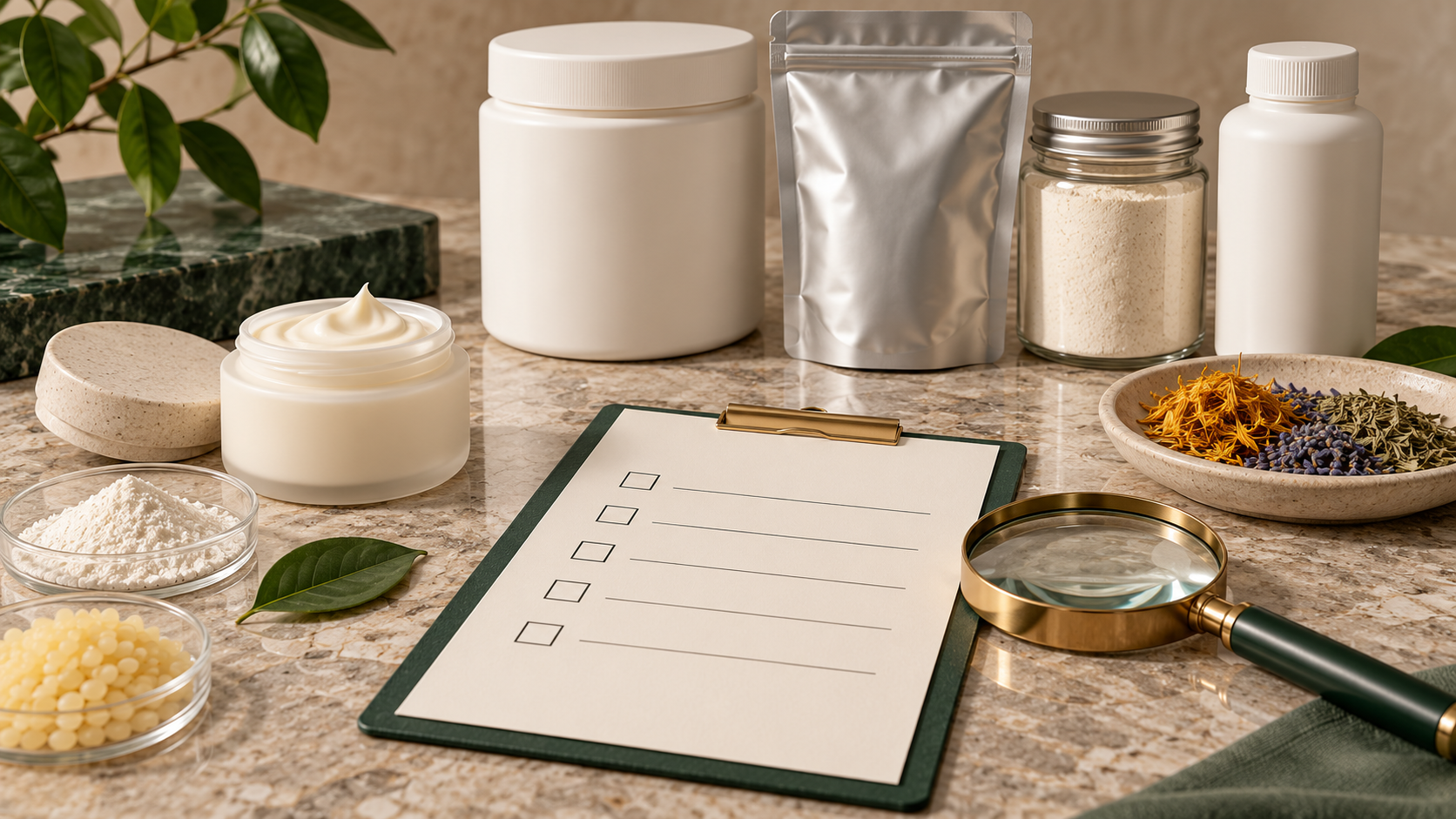
Ask how the manufacturer qualifies or reviews suppliers and how it confirms that an incoming material is the one ordered. Discuss the information needed for identity, relevant properties, storage, handling, and shelf life where applicable. The process should make it possible to connect the material lot used in a batch with the corresponding records.
A certificate of analysis, often called a COA, can be useful evidence about an identified material or lot. Read the document in context: who issued it, which lot it identifies, which methods and properties it covers, and whether it relates to the material received. A COA is one input to a material decision. It does not automatically answer every question about identity, suitability, storage, or the finished product.
Packaging components need similar attention. A bottle, pump, closure, liner, label, and carton can each have a specification and identity. Ask how the manufacturer checks that the correct component and artwork version have arrived and how it handles a damaged, mixed, or unexpected delivery. A package that looks similar to the approved sample may still differ in a way that matters to fit or dispensing.
Agree what happens when a material does not match the order or when required information is missing. The manufacturer may need to hold the material while the relevant team investigates. Define who can accept, reject, return, or otherwise dispose of it under the agreed process. Do not allow an unresolved discrepancy to become an informal substitution simply because a production date is approaching.
FDA's inspection checklist includes attention to raw materials, containers, closures, sampling, identification, and records. [1] Use those topics to frame questions for the proposed supplier. The actual checks and evidence should be selected for your product and evaluated by qualified personnel.
Follow the batch through processing
Once materials are accepted, the manufacturer needs a way to connect the approved instructions with the actual work performed. A batch record can identify the formula reference, manufacturing date, material lots, quantities, equipment, process steps, observations, and people responsible, as appropriate to the operation. The record should permit a reviewer to understand what happened rather than merely state that production was completed.
Begin with material identification and weighing or dispensing. Ask how the team confirms the correct material and quantity against the approved instructions, how containers are identified, and what happens if a discrepancy is found. If the manufacturer uses a digital system, ask how it controls access, records changes, and manages an exception. A digital record can support traceability, but the presence of software does not itself prove that the process is effective.
During processing, the manufacturer should use instructions suited to the formula and equipment. The applicable steps can differ widely between an oil, an emulsion, a cleanser, and other formats. The brand does not need to prescribe a universal mixing sequence, but it should understand how the agreed process is controlled and how critical information is recorded. Ask who can make a process adjustment and when the change must be escalated.
In-process checks help the team decide whether production is continuing as intended. Their purpose, timing, method, and acceptance criteria should be defined for the product. Depending on the process, checks may concern identity, appearance, a measured property, or another relevant characteristic. A check is useful when the team knows what action to take if the result is unexpected.
Transfer between vessels, holding, and movement to filling are also points to discuss. How is the material identified? What prevents a mix-up? What status must be confirmed before the next step? If a sample or result is pending, who decides whether processing can continue? The answers should fit the product and the manufacturer's documented procedures.
An unexpected event is not necessarily proof that the entire batch is unusable. It does require an appropriate decision. Record the event, identify potentially affected material, assess the possible impact, and determine the next action through the agreed quality process. A later summary should allow the reviewer to see the issue, investigation, and final disposition rather than hiding the event in a note.
Separate contamination control from product protection and stability
Microbiological quality involves more than one question. A manufacturer needs to consider the possibility of contamination during production, while the product development and safety teams also need to assess the finished formula and package for their intended use. These areas are connected, but one control does not replace the others.
FDA explains that harmful microorganisms can contaminate cosmetics through sources such as raw materials and water, manufacturing, ineffective preservation, packaging, storage, or consumer use. [7] The relevant risks depend on the formula and process. Ask the manufacturer how it identifies and controls the risks appropriate to the product, and ask the product specialists how they assess the finished product's microbiological protection.
Discuss the proposed testing and review plan rather than asking only whether a product has been “micro-tested.” What was tested, which formula and package were used, what method was applied, and what question did the result address? Who interprets the result? What action follows an unexpected finding? If a third-party laboratory is involved, agree on the information and reports that will be available to the people making the product decision.
FDA states that it does not have a single list of tests required for every cosmetic product or ingredient. [8] That does not remove the need for safety substantiation or other applicable obligations. It means that an appropriate plan must consider the particular product, available data, risks, and market rather than copying a generic panel without analysis.
Stability and shelf life are related but distinct questions. FDA notes that product type, storage, use, contamination, and changes over time can affect a cosmetic's shelf life. [11] Ask how the relevant team establishes the evaluation plan, which version and package were assessed, and how the results support the proposed storage and use period. A manufacturing check on one batch is not automatically a stability study or proof of a universal shelf life.
If the formula, preservative approach, manufacturing site, or package changes, ask qualified personnel to assess whether the existing evidence still applies. Record the decision and any additional work. The right question is not “Did we test once?” but “Does the evidence support this identified product and the decision we are making now?”
Control filling, packaging, and labeling
Filling and packaging turn bulk product into the units customers receive. Ask how the manufacturer confirms the correct bulk batch, container, closure, label, and outer package before the run. A clear identification process helps the team detect a mix-up between similar components or artwork versions.
The brand and manufacturer should agree which checks are relevant to the product. Depending on the package and process, the team may need to consider fill quantity, closure fit, sealing, dispensing, appearance, or the accuracy and legibility of printed information. The method and criteria should be appropriate to the actual product. Do not infer that a particular test or numeric tolerance applies universally.
Artwork control deserves attention. A formula or market change can affect the information a label needs to carry, and a packaging change may introduce an old or incorrect version. Identify the approved artwork, the person who approves it, how it is issued to production, and how the team handles unused or obsolete labels. A visual check during packing is useful only when the team knows which approved version to compare against.
Packaging quality checks do not by themselves establish that all claims and legal labeling requirements are satisfied. Those are separate product and market reviews. The manufacturing record should nevertheless connect the batch with the approved components and artwork so the parties can investigate if a later question arises.
Review batch records, deviations, and release
Before a batch is released, an authorized person needs a basis for deciding whether it meets the agreed requirements and whether outstanding issues have been resolved. The precise process and legal responsibilities depend on the product, facility, agreement, and market. A brand should ask the manufacturer to describe its actual review and disposition process rather than assuming one universal release form exists.

A review may bring together the approved formula and packaging references, material lots, production and filling records, in-process observations, laboratory results where relevant, and any deviations. The reviewer should be able to see whether the records refer to the same batch and whether the required steps were completed. FDA's inspection checklist discusses written procedures, batch identification, laboratory controls, and records as relevant review topics. [1]
A deviation is a departure from an agreed instruction, specification, or procedure. Examples might include an unexpected measurement, an identification discrepancy, or an interruption that requires assessment. The record should describe what happened and when, the material potentially affected, the immediate action, the investigation, and the final decision. A correction made on the floor should be visible to the later reviewer.
The investigation should be proportionate to the issue. Ask how the manufacturer considers product impact, whether other batches or materials could be affected, and what evidence supports the conclusion. If a cause is identified, the team may need corrective action and a way to check its effectiveness. If the cause remains unknown, the disposition should explain how uncertainty was handled and who had authority to decide.
Agree which situations require brand notification and whether the brand has an approval role. A supplier may have its own quality authority, while the contract may also give the brand specific rights to review or accept changes. Record both the operational process and the contact details needed to use it. A verbal assurance is difficult to reconstruct months later.
The final disposition may involve release, rejection, rework, further investigation, or another authorized outcome under the applicable procedures. Ask how the decision and the supporting evidence are retained. A release decision for one batch does not prove that every future batch will meet the same requirements; the controls and review must continue for subsequent production.
GMP, ISO 22716, and certificates: what do they show?
Good manufacturing practice, or GMP, refers to practices intended to support controlled manufacturing. A buyer should ask which requirements or standard the supplier applies, how the site assesses its own system, and what evidence is available. The term is more useful when it is connected to an identified facility, scope, and date.
ISO describes ISO 22716 as guidelines for the production, control, storage, and shipment of cosmetic products. [6] The publicly available abstract gives an overview; it does not establish that a particular factory follows the guideline or has an independent certification. The full standard was not reviewed for this article. If it is relevant to your project, obtain and assess the current applicable material through the appropriate channels.
In the EU, Article 8 of the cosmetics regulation requires manufacturing to comply with GMP and provides a presumption of compliance with that requirement where manufacture follows relevant harmonised standards whose references have been published in the Official Journal. [4] The European Commission lists EN ISO 22716:2007 in its summary of harmonised standards. [5] The Commission also explains that its summary list has no independent legal effect. For an actual decision, confirm the operative Official Journal reference, current legislation, site, and product context with a qualified professional.
That presumption concerns the GMP requirement. It is not a general approval of the product, evidence that each batch meets every specification, or support for a marketing claim. The EU framework also includes distinct product safety assessment and information requirements. [4] The EU and the United Kingdom have separate legal frameworks; do not assume a conclusion for one automatically applies to the other.
In the United States, MoCRA directs FDA to establish cosmetic GMP regulations and includes other provisions relevant to the cosmetics industry. [3] FDA's 2013 cosmetic GMP draft guidance is identified by the agency as a draft, nonbinding, and not for implementation; FDA states that it intends to revise or withdraw it as appropriate in connection with MoCRA rulemaking. [2] This article does not determine the status of every later rule. Check current requirements for the actual facility, product, and date instead of treating the historical draft or inspection checklist as a final universal regulation.
When reviewing a certificate or audit report, identify the issuing organization, legal entity, site address, activities, products or scope, dates, and any conditions or limitations. Ask how current status can be independently verified and whether the audited site is the one that will perform the work. Consider what the audit actually assessed and whether any findings were resolved. A certificate presented without its scope provides limited information.
Do not confuse registration with certification or approval. FDA states that it does not issue certificates showing compliance with cosmetic facility registration or product listing requirements, and that registration and listing numbers do not mean FDA has approved the facility or product. [10] Request the evidence appropriate to the specific claim being made, and verify it through the relevant authority where possible.
Plan traceability, complaints, and recall readiness
Traceability is the ability to connect relevant records across the product's journey. The level of detail and retention requirements depend on the applicable law and agreement, but a practical discussion begins with the batch identifier. Ask how the manufacturer connects it to material lots, production and packaging records, finished goods, and the information needed to identify affected product if a problem is found.

The brand should also understand its own distribution records. A manufacturer may know which batches it shipped to the brand, while the brand or distributor may hold information about onward sales. Decide who retains each part of the chain, how quickly the parties can retrieve it, and whom to contact outside normal business hours. Test the process with a realistic exercise where appropriate, while recording any gaps and improvements.
Complaints need a defined route from the person receiving them to the people who can assess product risk. Agree on the information to collect, how to identify the product and batch, how samples or photographs will be handled if available, and how the manufacturer and brand will communicate. Not every complaint is an adverse event or requires a recall. Each needs triage and a decision appropriate to its facts.
For the US, MoCRA includes serious adverse-event reporting provisions for the relevant responsible person and grants FDA mandatory recall authority under specified conditions. [3] FDA issued final guidance in October 2026 explaining aspects of its mandatory cosmetic recall process. [9] Voluntary action and mandatory authority are distinct, and a complaint does not automatically meet the conditions for either. Identify the actual legal responsibilities and seek qualified advice for the specific incident and market.
Ask who can place stock on hold, decide whether further investigation is needed, communicate with distributors, and approve public or regulatory communications. A recall plan should name decision makers and practical steps rather than rely on a generic statement that “the supplier will handle it.” Update the contact list and rehearse the information flow as the relationship changes.
What documents should a brand request?
The right document set depends on the product, risk, contract, and the information each party needs to perform its responsibilities. Start with a list of decisions the brand must make, then ask which records support those decisions. Agree on confidentiality, access, and retention before a problem occurs.
| Topic | Questions to ask | Evidence to discuss |
|---|---|---|
| Site and quality system | Which entity and facility will do the work? What activities are covered by an audit? | Current certificate or audit scope, dates, issuer, verification route, and relevant findings or summaries |
| Product specification | Which formula, components, artwork, and acceptance criteria govern this order? | Controlled product, packaging, and artwork references and change history |
| Incoming materials | How are lots identified, reviewed, and linked to production? | Relevant material specifications, COAs, status records, and supplier information |
| Batch review | What will the authorized reviewer assess before disposition? | Agreed batch documentation, relevant results, deviations, and release or rejection record |
| Change and issue management | Who investigates and who must approve or receive notice? | Quality agreement, change-control procedure, deviation and complaint contacts |
| Traceability | Can the parties identify affected material and customers? | Batch identification, shipping records, retrieval process, and exercise results where available |
This table describes questions and possible evidence, not a mandatory package for every project. Some records may contain confidential formula details or other protected information. The parties can agree on appropriate access for a qualified auditor or assessor, a controlled summary, or another method that lets each party meet its responsibilities without unnecessary disclosure.
When a document is provided, check that it answers the question. A certificate for a different facility does not establish the status of the proposed production site. A report for an earlier formula or package needs a relevance assessment before it is used for the current one. An FDA registration number is not a product approval. [10] Record gaps and the person responsible for resolving them.
A hypothetical incoming-material discrepancy
Consider a fictional brand and manufacturer preparing a lotion batch. The approved specification identifies a particular packaging component and the information required when it arrives. The delivery label and the purchase documentation do not match. The example is illustrative; it does not describe a YOUREE facility, an actual batch, or a test result.
Under their agreed process, the receiving team identifies the affected delivery and holds it while the discrepancy is reviewed. The manufacturer checks the order, supplier information, component identity, and records. It informs the brand if the quality agreement requires notification. The relevant personnel decide whether more information or an inspection is needed.
The final decision is documented before the component is used, returned, rejected, or otherwise handled. If the supplier proposes a substitute, the team reviews it as a change rather than silently treating it as the original component. That review may involve fit, function, compatibility, artwork, or other considerations selected for the actual product.
The value of the example is the sequence: identify, contain, investigate, decide, and retain a record. The outcome depends on the facts. No particular test, acceptance limit, or disposition can be assumed from the scenario alone.
Frequently asked questions
Does an ISO certificate mean my cosmetic product is approved?
No. A certificate or audit may describe an assessment of a facility or system within a stated scope. It does not automatically establish that every product, batch, or claim is approved or compliant in every market. Check the holder, site, activities, dates, issuer, and current status, then assess the product and batch evidence separately. [5, 6]
Is a finished-product test enough to establish manufacturing quality?
A finished-product result can answer a specific question about the sample and method used. It does not describe every material, process step, or event in the batch. Review the agreed specifications, manufacturing controls, records, and deviations as well as the relevant results. The appropriate evidence depends on the product and decision. [1, 8]
What should happen if a result falls outside an agreed specification?
The manufacturer should follow its applicable quality process and the parties' agreement. Ask how the affected material is identified, how the result is assessed, who investigates, and who can authorize a disposition. The cause and impact need evidence; an unexpected result should not be ignored or automatically explained away. The outcome depends on the investigation and applicable requirements.
Can a supplier change a raw material after the product is approved?
Changes should follow the agreed change-control process and applicable requirements. Identify what is changing, why, and which product versions and batches are affected. Qualified personnel should assess the effect on specifications and existing evidence before the change is accepted. The contract should identify who must be notified and who has approval authority.
Who is responsible for quality and regulatory compliance?
The manufacturer, brand, distributors, and other parties may have different responsibilities under their agreement and applicable law. A contract can assign activities and information flows, but it does not by itself remove duties imposed by law. Identify the actual entities, locations, product, and markets, and obtain qualified advice on the duties that apply.
What is the difference between a complaint and a recall?
A complaint is information about a concern or problem that needs appropriate triage. A recall is a separate action involving product in distribution and depends on the facts, risk, decision makers, and applicable law. Some events may require reporting or other action. In the US, FDA's mandatory cosmetic recall authority has specified conditions; not every complaint triggers its use. [3, 9]
Make the next quality conversation specific
An effective supplier review asks for more than a list of certificates. Identify the actual product, manufacturing site, approved specifications, batch controls, decision makers, and records that connect them. Then agree how the parties will handle changes, unexpected results, and information needed after shipment.
Prepare your product format, intended markets, packaging direction, required documents, and questions about quality responsibilities before speaking with a manufacturing partner. The right evidence and the right review process can then be discussed for the actual project.
References
Sources checked 31 October 2026. Regulations and standards can change. The ISO description is based on its public abstract; the full paid standard was not reviewed. Confirm the current legal text and applicable requirements for the specific product, facility, and market.
- US Food and Drug Administration. Good Manufacturing Practice (GMP) Guidelines/Inspection Checklist for Cosmetics.
- US Food and Drug Administration. Draft Guidance for Industry: Cosmetic Good Manufacturing Practices, June 2013, FDA update 3 May 2023.
- US Food and Drug Administration. Modernization of Cosmetics Regulation Act of 2022.
- European Union. Regulation (EC) No 1223/2009 on cosmetic products, historical consolidated text as of 16 April 2015, Articles 8, 10 and 11. Check the current consolidated text and amendments before a project decision.
- European Commission. Harmonised standards: cosmetic products.
- International Organization for Standardization. ISO 22716:2007, Cosmetics — Good Manufacturing Practices (GMP) — Guidelines on Good Manufacturing Practices, public abstract.
- US Food and Drug Administration. Microbiological Safety and Cosmetics.
- US Food and Drug Administration. Product Testing of Cosmetics.
- US Food and Drug Administration. FDA Issues Final Guidance on Mandatory Cosmetic Recalls, 22 October 2026.
- US Food and Drug Administration. Registration & Listing of Cosmetic Product Facilities and Products, updated 9 September 2026.
- US Food and Drug Administration. Shelf Life and Expiration Dating of Cosmetics.
Developing a product of your own?
Share your brief with our team to explore formula, packaging and sampling options.
Discuss your project