
A cosmetic formula is a coordinated system, not simply a list of attractive ingredients. Water, oils, texture ingredients, preservation systems, fragrance and other components can each contribute to the way a product looks, feels, dispenses and remains suitable during its intended use. Their effects depend on the complete formula, the manufacturing process, the package and the conditions in which the product is stored and used.
For a beauty brand, the first task is to describe what the finished product needs to do. The name of an ingredient can help start a development conversation, but it does not establish the concentration, quality, performance or safety of a finished product. A study of an ingredient or model formula also does not automatically prove a claim for your own product.
This guide explains common ingredient functions and the questions a non-formulator can ask. It does not provide a recipe or a universal list of ingredients to use. A qualified formulation team and relevant safety professionals need the actual product details, use conditions and target markets to make project-specific decisions.
What a cosmetic formula does
A brand might ask for a lightweight moisturizer, a rich body cream, a clear cleansing gel or a leave-in hair product. Each brief describes a different experience. The formulator's task is to turn the brief into a product system that can be made, evaluated, packaged and used as intended. The work involves choices about the product's structure, its ingredients and how those ingredients interact.
Start by separating the experience you want from the claim you want to make. “Spreads easily and leaves a comfortable finish” can describe a sensory objective for sample feedback. A statement about a measurable product effect needs an evidence plan suited to the claim, the finished product and the audience. A brand should not assume that a desirable ingredient name proves either outcome.
The package is part of the development discussion. A thick cream, for example, may behave differently from a thin lotion when dispensed through a particular pump. A change in formula can affect the questions the team asks about the container, closure and compatibility. Equally, a packaging change can affect the product experience. Review the formula and intended package together rather than choosing each in isolation.
Research on model emulsions shows why context matters. In one study, changes in the composition of a specific model emulsion affected aspects of the residue measured after application. [12] That observation supports a general discussion of the formula as a system; it does not establish the performance, safety or sensory effect of an unrelated commercial product. Ask what evidence applies to the actual version your brand plans to sell.
Read an ingredient list without overinterpreting it
An ingredient list is an important label, but it is not a complete manufacturing formula. The list does not normally tell a buyer the precise concentration of each ingredient, its supplier, its full specification, the processing method or the conditions used to evaluate the finished product. It also does not establish who owns the formula or whether the supplier can transfer it to another facility.
In the United States, the FDA explains that ingredients in consumer retail cosmetics are generally declared by common or usual names in descending order of predominance. The rules include exceptions, including specified treatment for ingredients present at one percent or less and for certain color additives. A product that is both a cosmetic and a drug has additional labeling considerations for active ingredients. [2, 3] Those US rules should not be assumed to apply unchanged in every market.
This means that a reader cannot calculate exact percentages from the order alone. Nor should a buyer infer that an ingredient near the end of a list is ineffective or that the first ingredient by itself determines the whole product's quality. The name, amount, quality, combination, finished-product design and intended claim are separate questions. The responsible technical team needs more information than a label provides to assess them.
In the European Union, the European Commission's CosIng database provides information on cosmetic substances and ingredient names. The Commission states that inclusion in the database does not itself constitute permission to use a substance in cosmetics. The applicable regulation, its annexes and the circumstances of use need to be checked for the actual product. [1] Treat CosIng as a research aid, not a substitute for a current regulatory review.
When comparing two sample products, ask for the information your role legitimately requires. A manufacturer may be able to describe the purpose of key ingredients, relevant specifications, restrictions or evidence without sharing every confidential processing detail. Agree on who receives sensitive information and how a qualified safety assessor can obtain what is needed. Confidentiality should not be used as a reason to make an unsupported product claim.
Water, oils and product formats
Many skincare products contain a water phase, an oil phase or a combination of the two. A water-based solution can carry ingredients that are compatible with its aqueous environment. An oil-based product may use materials selected for an oil-based system. An emulsion combines phases that would otherwise separate, using an appropriate system to help form and maintain the intended structure. These are conceptual categories; actual formulas can be more complex.

An emulsion has a dispersed phase and a continuous phase. In a simple oil-in-water model, small portions of an oil phase are dispersed within a continuous water phase. In a water-in-oil model, the relationship is reversed. The description helps a brand discuss the product structure, but it does not by itself promise a particular texture, shelf life or performance. Formulators assess the complete system and its intended use.
Ask how the proposed format fits the brief. A product intended to spread through a pump, remain on the skin as a rich cream or rinse away during cleansing may call for different choices. A transparent appearance, a particular fragrance and a preferred container can also introduce constraints. Discuss these objectives together before treating any one ingredient as non-negotiable.
A product described as anhydrous generally has no water intentionally included in its formula. That label alone does not prove that the finished product has no microbiological risk. Raw materials, manufacturing conditions, packaging and consumer use can all matter. FDA identifies several possible routes of cosmetic contamination, including materials, production, packaging and handling. [5] The team should assess the actual product rather than relying on the format name as a safety guarantee.
Humectants, emollients and occlusive ingredients
Brands often hear the terms humectant, emollient and occlusive when discussing moisturizing products. They describe functional roles, not separate boxes into which every ingredient fits perfectly. One ingredient can contribute more than one function, and the finished experience depends on the formula around it.
A humectant is generally discussed as a material that can attract or retain water in a product or on a surface. Glycerin is a familiar example used in many cosmetic contexts. The presence of a humectant does not tell you how a particular product will feel or establish a claim about how long it moisturizes. Ask what the ingredient is intended to contribute and how the team will evaluate the final product.
Emollients are commonly discussed in relation to skin feel and surface properties. An emollient may be selected to support a particular sensory direction, such as a softer or smoother-feeling finish. Different oils, esters or other materials can have different characteristics in a formula. Their contribution depends on the amount, combination, product format and use. A product brief that describes the desired finish is more useful than assuming one named oil will achieve it on its own.
An occlusive ingredient is discussed in relation to forming a barrier that can reduce water loss from the skin surface. The term describes a function, not proof that any given product will produce a particular measured benefit. The team must consider the complete product, the relevant claim and the evidence appropriate to it. A material selected for an occlusive role may also affect the product's feel or compatibility with other ingredients.
A small study of prepared creams examined changes in properties after application and found that composition and application conditions mattered in the studied systems. [11] It does not rank ingredients for every moisturizer or prove a result for another product. For a buyer, the practical lesson is to discuss the full sensory and evidence plan: what should the user notice, under what conditions, and how will your team decide whether a sample meets that objective?
Avoid asking only for “more” of a desirable ingredient. A change can influence cost, texture, compatibility or the evidence needed for a claim. The technical team should explain the consequences and document which formula version was evaluated. More of a particular ingredient is not automatically better, safer or more effective.
Emulsifiers, surfactants and cleansing systems
Emulsifiers and surfactants can help formulators build a product's structure or support cleansing. A surfactant is a material whose behavior at an interface can be useful in systems involving water, oil or surfaces. Depending on the material and system, a formulator may use surfactant properties in an emulsion, a cleanser or another product format. The precise role is determined by the formulation, not by a single marketing label.
In an emulsion, the team considers how the phases are combined and how the resulting structure behaves through storage and use. An emulsifier system can help create the intended dispersion, but naming an emulsifier does not guarantee that the finished product will remain stable. The entire composition, manufacturing process, packaging and evaluation plan matter. The published model-emulsion research cited earlier is an example of how multiple components influence a studied system, not a universal recipe. [12]
In a cleansing product, the brand may care about how the product spreads, rinses, foams or feels after use. Ask the formulator to explain how those objectives interact and how sample feedback should be collected. A foam preference is a sensory requirement; it is not by itself evidence of cleaning performance or skin compatibility. Record each sample version and compare it under consistent, appropriate conditions.
Do not assume that all surfactants are irritating or that a particular ingredient is suitable for every user. Individual responses, the product as a whole and its use conditions matter. Likewise, an ingredient used in one product format should not automatically be copied into another without professional review. Ask what information supports the proposed use and what remains to be evaluated for the finished product.
If the team proposes changing an emulsifier or cleansing system, discuss the effect on the sample and on existing evidence. A formulation change may require review of physical behavior, compatibility or claims, but the appropriate response depends on the actual change and risk. Avoid treating every revision as identical or assuming that all previous results remain applicable.
Thickeners, stabilizers and pH adjustment
Texture is a commercial decision as well as a formulation question. A product may need to stay in a jar, flow through a pump or spread in a particular way. Thickening or structuring ingredients can contribute to viscosity and sensory feel. Viscosity describes resistance to flow; it is useful for discussing whether a product pours, spreads or dispenses as intended.
A thicker sample is not automatically more stable, safer or more effective. A formula can look uniform at one point in time and still need an appropriate evaluation for storage and use. A texture change can also affect the package or the user's experience. Ask the development team what it means by “stable,” what observations are relevant and which version and conditions the proposed evaluation will cover.
The term stabilizer can be used for different functions. One material might support a particular physical structure, while another may be selected for a different formulation concern. Ask the formulator to name the risk being managed instead of assuming that a single “stabilizer” solves every stability problem. A useful project record distinguishes physical observations, product safety, microbiological protection, package function and claim evidence.
pH is another property that needs context. It can be relevant to the behavior of an ingredient, the overall formula, product use or a particular evaluation. A number without a measurement method, product context and applicable specification does not explain whether a formula is suitable. There is no single pH range that can be prescribed for every cosmetic in a general buyer's guide.
Ask which property the team intends to control, why it matters for the actual product and how it will be checked. If a target cannot be met without changing another requirement, document the trade-off. A brand may need to reconsider a sensory preference, a material choice or a package rather than asking for an isolated number to be changed without assessing the system.
Preservatives and microbiological protection
Microbiological protection concerns whether a product is suitably protected against harmful microorganisms during manufacture, storage and reasonably foreseeable use. It is a whole-system question. FDA describes possible contamination routes including raw materials, water, manufacturing conditions, inadequate preservation, packaging, storage and consumer handling. [5] A preservation ingredient is one possible part of the strategy; it is not a guarantee on its own.
Ask the technical team how it assesses the particular formula and how the package and intended use affect that assessment. A product repeatedly opened by a consumer may raise different questions from a product used in another way. The correct assessment depends on the product, materials and evidence, not on an assumed risk from a package name alone.
Avoid blanket statements that all preservatives are harmful or that every product described as preservative-free is unsafe. The term on a marketing label does not explain the complete formulation or the applicable safety evidence. Conversely, an attractive label is not proof that the product is protected. A qualified team should choose an appropriate approach and explain the information it needs.
For the brand's development record, identify the formula version, the proposed package, the intended use and the owner of the evaluation. Ask whether changes to a material, process or component need further review. Do not publish a product-specific safety claim merely because a supplier says a general method exists.
Fragrance, color and the sensory brief
Fragrance, color and botanical materials may contribute to how a product is perceived. They can also add formulation, labeling or individual-sensitivity questions. A clear brief should distinguish what the brand wants the user to experience from any claim about the source, safety or effect of an ingredient.
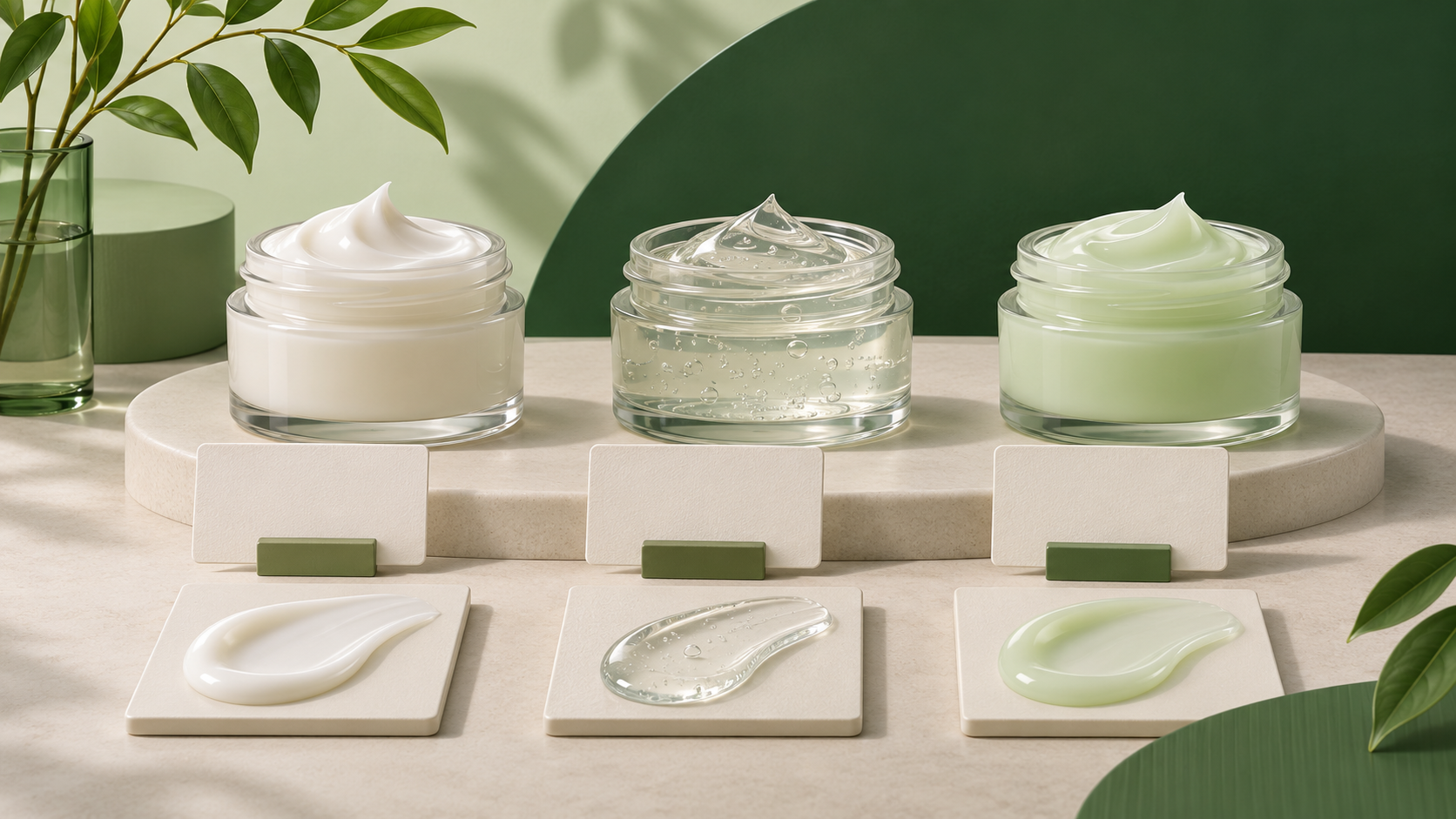
FDA explains that fragrances can be mixtures of ingredients and that, under certain US labeling rules, fragrance or flavor may be declared using a general term. The agency also notes that some individuals can be sensitive to fragrance ingredients. [6] This does not mean that every fragranced cosmetic is unsuitable, or that removing fragrance eliminates all possible reactions. Review the complete formula and the target market's current disclosure requirements.
Color selection also requires product and market context. Do not assume that a colorant permitted in one use or jurisdiction is permitted in every other use. The responsible technical and regulatory professionals should check the exact material, intended area of application and applicable current rules. A visual match to a reference product does not establish that the same ingredients or permissions apply.
Terms such as “natural,” “clean” and “hypoallergenic” need particular care. FDA states that natural or organic origin does not itself guarantee cosmetic safety. [4] FDA also discusses allergens in cosmetics and the possibility that people react to different substances. [7] A marketing term cannot establish that no individual will experience a reaction. Ask what the term means in your project, what it communicates to the intended audience and what evidence and market rules support its use.
Do not infer a botanical material's full identity or quality from a familiar plant name. The technical team may need information about the material's identity, composition, impurities, supplier specification and intended use. The European Scientific Committee on Consumer Safety discusses identity, purity and exposure among the considerations in ingredient safety assessment. [10] Those considerations do not automatically establish the safety of a particular material or finished product.
How to assess an ingredient-led claim
An ingredient can be a useful part of a product story, but an ingredient story and a finished-product claim are different things. Begin by writing the exact statement your brand intends to make. Then ask what the statement would lead a reasonable reader to understand about the product, who is expected to use it and under what conditions.
Next ask what evidence relates to that statement. A supplier may provide information about a material, a laboratory study or a published paper. The responsible team should identify what was studied, the conditions, the population if people were involved, the formulation and the outcome actually measured. A study of an ingredient in one system does not automatically establish the same effect in a different finished product.
The formulator may also need to consider the identity and specification of the proposed material, its role and compatibility in the formula, and whether the product's design affects the evidence plan. Ingredient grade, impurities and intended exposure are among the kinds of information that can matter in a safety assessment. [10] An ingredient name on a label does not supply all of these details.
Published studies can help identify questions, not replace project-specific evidence. The studies cited in this article examined particular prepared creams or model emulsions under defined conditions. [11, 12] They do not prove a particular moisturizer sold by your brand will have the same sensory or biological result. If the proposed claim needs finished-product evaluation, identify who will design the appropriate work, review the result and approve the language.
The same discipline applies to a comparison. If a brand wants to say that a product is gentler, longer-lasting or more effective than another, define the comparison and evidence needed before printing the claim. Do not assume that a named ingredient, an appealing product texture or a supplier's general marketing statement proves it. Ask qualified advisers to review claims for the actual destination market.
Regulatory and labeling questions for different markets
Product classification is a starting point for the regulatory conversation. In the United States, FDA explains that intended use and claims can determine whether a product is regulated as a cosmetic, a drug or both. Sunscreen is one example used in FDA guidance to illustrate how a product can have more than one regulatory category. [8] The marketing use of the word “active” does not by itself settle the classification of an unspecified product.
For a US retail cosmetic, check the applicable labeling rules, ingredient naming and any relevant exceptions for the actual product. [2, 3] If the product is also a drug, further requirements may apply. Do not describe a cosmetic ingredient list as a complete safety report or claim that an ordinary cosmetic has been approved by FDA simply because it is sold or listed.
For the European Union, the Commission describes a framework that includes an EU responsible person, a cosmetic product safety report and product notification. [9] The technical team should check the current status and conditions for each relevant ingredient and the complete product. CosIng can assist research but does not itself authorize an ingredient. [1] EU rules should not be presented as rules for the United Kingdom or every other market.
A brand entering several markets should ask which version of the formula and label is intended for each one. The same product idea may require different questions about ingredients, claims or documentation. Keep decisions linked to the actual product, jurisdiction and date; retain professional review records and revisit them when the formula, claims or applicable rules change.
A fictional moisturizer brief
Consider a hypothetical brand planning a leave-on moisturizer. This example is a discussion aid, not a real product, recipe or claim. The brand wants a product that spreads easily, feels comfortable after application and works with its chosen container. It has not yet decided which sensory preferences are essential and which are negotiable.
The team first describes the intended user, area of application, use conditions and target markets. It then discusses the possible product structure and the roles that ingredients may play: for example, water-related functions, a sensory direction, a way to create the desired structure and a suitable approach to microbiological protection. The team does not assume that one featured ingredient will deliver every objective.
The formulator presents identified sample versions for review. The brand records observations about appearance, application, fragrance and dispensing, using the same conditions where practical. If it requests a change, the team records the new version and considers what prior observations remain relevant. A sample preference is a development decision, not a substitute for safety, stability, packaging or claim assessment.
Before approving the next stage, the parties identify the final formula version, intended package, outstanding evaluations, proposed claims and responsible decision makers. The example deliberately gives no percentages, processing instructions or predicted results. Those details would require a real product, appropriate expertise and project-specific evidence.
Questions to ask a formulation partner
A useful discussion makes the product system and its open questions visible. Ask the team to explain the following in language appropriate to your role:
- What is the product intended to do, how will it be used and which markets are in scope?
- What roles do the main ingredient groups play in the proposed format and sensory direction?
- Which requirements are essential, which are preferences and where are the main trade-offs?
- What information is needed about material identity, supplier specification, quality and potential impurities?
- How are sample versions identified, and how should the brand record feedback?
- Which observations or evaluations are proposed for the formula, package, intended use and claims?
- What existing evidence is relevant to the actual version, and what remains to be assessed?
- How will a change in ingredient, package, process, claim or destination be reviewed and approved?
- Who needs access to confidential formula information for safety or regulatory work, and how will that access be arranged?
- What decisions remain open before the formula can be handed over for the next project stage?
Ask for a written response that distinguishes a confirmed decision from an assumption or an item still under review. If an answer depends on a later sample or assessment, record the dependency and the person responsible. Do not treat a preliminary idea as an approved specification.
A good handover identifies the product and formula version, the package to which the discussion applies, the intended market, the agreed sensory objectives, the evidence available and the work still outstanding. The brand should understand what it has approved and what the approval does not cover. Different parties may make sensory, safety, regulatory and production decisions; those checkpoints should not be collapsed into a single vague sign-off.
Frequently asked questions
Does the ingredient list show the full formula?
No. The label identifies ingredients according to the applicable rules, but it does not normally reveal exact percentages, complete material specifications, processing conditions or ownership. US ordering rules include exceptions, so order alone cannot be used to reconstruct the formula. [2, 3]
Is a product better if it contains more of a highlighted ingredient?
Not necessarily. The ingredient's function, specification, compatibility with the formula and evidence for the finished product all matter. A change can affect texture, stability, safety assessment or a claim. Discuss the objective and ask the technical team to explain the trade-offs for the actual formula.
Can one ingredient be both a humectant and an emollient?
Ingredients can have more than one functional role, depending on the material and how it is used. The useful question is what role the ingredient is intended to play in the particular finished formula, not whether a short label captures every property.
Does a fragrance-free or natural product guarantee that nobody will react?
No. Individuals can be sensitive to different substances, and natural origin does not by itself guarantee safety. [4, 7] Review the complete formula and use appropriate evidence and market-specific labeling advice rather than promising that every user will respond in the same way.
Does anhydrous mean that a product cannot become contaminated?
No. A product's water content is only one part of the assessment. Raw materials, manufacture, package, storage and consumer use can also matter. [5] The responsible team should assess the actual product and its foreseeable conditions of use.
Can a published study of an ingredient support a finished-product claim?
It may provide useful background, but its relevance depends on what was studied and what your brand intends to claim. A qualified reviewer must consider the study conditions and the actual finished product. Additional evidence may be needed; do not imply that a study of a different preparation proves your product's result.
Start with the finished-product brief
Describe the intended user, experience, package, claims and destination before choosing an ingredient as the center of the project. Ask your formulation partner to explain the role of proposed materials, the important trade-offs and the information needed to assess the final version.
Keep sample feedback, technical decisions and outstanding evidence linked to identified versions. That record gives your team a better basis for discussing the next stage of development and for making claims that fit the product and its actual supporting evidence.
References
Sources checked 4 November 2026. Regulatory requirements and guidance may change; verify the current rules for the actual product, claim and market.
- European Commission. Cosmetic ingredient database.
- US Food and Drug Administration. Cosmetic Ingredient Names.
- US Food and Drug Administration. Summary of Cosmetics Labeling Requirements.
- US Food and Drug Administration. Product Testing of Cosmetics.
- US Food and Drug Administration. Microbiological Safety and Cosmetics.
- US Food and Drug Administration. Fragrances in Cosmetics.
- US Food and Drug Administration. Allergens in Cosmetics.
- US Food and Drug Administration. Is It a Cosmetic, a Drug, or Both? (Or Is It Soap?).
- European Commission. Cosmetics legislation.
- Scientific Committee on Consumer Safety. The SCCS Notes of Guidance for the Testing of Cosmetic Ingredients and Their Safety Evaluation, 12th revision, corrigendum 2, 2023.
- Salehi, N., Mortazavi, S. M., and Moghimi, H. R. Investigating the Changes in Cream Properties Following Topical Application and Their Influence on the Product Efficiency. Iranian Journal of Pharmaceutical Research, 2022.
- Faucheux, E., et al. Residual film formation after emulsion application: Understanding the role and fate of excipients on skin surface. International Journal of Pharmaceutics, 2020.
Developing a product of your own?
Share your brief with our team to explore formula, packaging and sampling options.
Discuss your project