A useful cosmetic stability plan connects a specific formula and package with the conditions in which the finished product is expected to be stored, transported and used. It asks what changes matter, how those changes will be observed, and what evidence the responsible team needs before making a shelf-life or labeling decision.
There is no single testing period, temperature or acceptance limit that can be applied to every cosmetic. A stability report supports a product-specific decision; it does not by itself prove that a product is safe, effective, legally compliant or suitable for every market. The exact formula version, packaging components, manufacturing context and intended use matter.
For a beauty brand, the practical first step is to identify the product you intend to sell and ask a qualified technical team to explain what evidence applies to that version. This guide describes the questions to ask, the records to request and the limits of common stability terms. It is not a test protocol or a shelf-life prediction for an individual product.
What stability testing can and cannot tell you
Cosmetic products can change over time. A cream may change in appearance or consistency, a fragrance may change, or a dispensing component may behave differently after storage. Other changes may not be obvious by looking at the product. The characteristics that matter depend on the formula, the package and the intended use.
A stability plan can help a team investigate whether selected characteristics remain within justified criteria under defined conditions. Those characteristics may include physical appearance, relevant chemical properties or the function of the package. The plan should state what is measured, why it matters, how the team will interpret a result and who is responsible for the decision.
The International Organization for Standardization's public abstract for ISO/TR 18811 describes a framework for identifying suitable approaches to cosmetic stability. It states that the report does not specify universal conditions, parameters or criteria, and that the manufacturer must justify an appropriate protocol for the product. [1] The publicly available abstract does not establish a testing schedule or result for your product; the full technical report was not reviewed for this guide.
Stability is one part of a wider evidence picture. A product that still looks uniform after storage has not automatically been shown to be microbiologically safe. A product that dispenses well has not necessarily been shown to support every marketing claim. FDA explains that safety substantiation may use relevant existing information and appropriate additional testing, and that it does not provide one universal test list for every cosmetic. [3] The team needs to assess each question on its own merits and understand how the findings relate to the finished product.
A report also has boundaries. It describes samples, methods, conditions and observations. Whether those findings support a commercial shelf-life decision depends on the quality and relevance of the evidence, the product's intended use and the applicable market. Ask the technical reviewer to identify any uncertainty and outstanding work, rather than treating a report title or a “pass” label as a general approval.
Shelf life, minimum durability and period after opening
Shelf life is often used to describe the period during which a product is expected to remain suitable under stated storage and use conditions. The phrase must be tied to an actual product and a defined decision: which characteristics are expected to remain acceptable, which conditions are assumed, and what evidence supports the conclusion? A number without those assumptions can give the brand false confidence.
An unopened product and a product in repeated use may face different conditions. A sealed container in a warehouse may experience temperature or light exposure, while an opened product can also be exposed to air, handling or contact with a user's fingers. The package, product and expected behavior all affect which questions need to be addressed. The fact that one stage was assessed does not automatically settle the other.
In the European Union, minimum durability and, where applicable, a period after opening are distinct labeling concepts. Historical European Commission guidance discusses the evidence relevant to stability, minimum durability and the period after opening where applicable. [4] The responsible team must check the current regulation and guidance for the actual product and decide which information and labeling are required. Do not copy a duration from a competitor's package or assume that every cosmetic uses the same marking.
US practice is different. FDA states that, for cosmetics generally, US law does not require a specific shelf life or an expiration date on the label, while manufacturers remain responsible for product safety. Products that are also drugs have different requirements. [2] That US overview is not a rule for the EU, the UK or another destination, and it does not mean a manufacturer can ignore product deterioration.
For a brand selling in multiple markets, keep three questions separate: what the evidence says about the product under stated conditions, what the responsible team concludes about durability or use, and what each market requires on the label. A label is the result of a project-specific decision; it is not a replacement for the underlying evidence.
Identify the product before commissioning a study
The first page of a useful stability brief identifies the sample. Record a formula name and version, the batch or sample identity, the manufacturer or laboratory responsible for preparing it, and the date or stage of preparation. Note which information is confirmed and which may still change before commercial production.
A sample made for a sensory discussion may not be identical to the product that will be marketed. Differences can include a formula revision, a material substitution, a change in manufacturing scale or process, or a different container and closure. A qualified person must decide whether the existing evidence remains relevant. Do not assume that every change invalidates every study, but do not silently transfer a result from one version to another.
Identify the complete package. A bottle, jar, pump, liner, closure and any other relevant component can form part of the conditions in which the product is stored and used. Ask the supplier to record the component specifications and the configuration used for each sample. A visually similar container is not necessarily the same component for the purpose of a technical assessment.
The intended use also shapes the questions. Is the product left on or rinsed off? Where is it applied? How is it dispensed and how might the user handle it? What storage and transport conditions are reasonably foreseeable for the chosen distribution route? Which destinations and claims are in scope? A general answer such as “normal use” is less useful than a brief that describes the real product and its expected journey.
The European Commission's historical safety-report guidance discusses the need to connect stability evidence to the composition that will be placed on the market and to consider the packaging where relevant. [4] Use that principle in the project record, while asking the responsible professionals to verify the current requirements for the intended market.
Build a justified stability plan
A stability plan starts with a decision. The team should state what it is trying to learn and how the information will be used. One question might concern changes in appearance during storage; another might concern a package's ability to dispense the product as intended. These questions may require different observations and should not be hidden behind a single line reading “stability test included.”
The plan should identify the product and package, the proposed samples and comparison points, the relevant conditions, the timing of observations, the characteristics to be measured and the acceptance criteria. It should also identify who selected the approach, who will carry it out, who reviews the results and how deviations will be documented. The actual choices need technical justification for the specific product; this article does not prescribe them.
Ask the laboratory or responsible technical team to explain each major choice. Why is a condition relevant to the product's expected storage or use? What is the purpose of the comparison sample? Which characteristics could affect the decision? What would prompt an investigation? How will the team handle a sample that cannot be assessed as planned? A concise rationale helps the brand understand the scope without pretending that every technical method is interchangeable.
Agree on the report and its ownership before work begins. The brand may need enough information for its responsible person, safety assessor or other appointed professional to judge the evidence. Discuss whether the report can be shared confidentially with those parties, what raw observations or summaries will be provided, and how later questions or corrections will be handled. Access to evidence is a project term to confirm, not something established by a generic quotation.
A plan may evolve as the product changes. If a sample, package or intended claim changes during development, record the change and ask the technical owner to assess its effect. The answer might be that existing evidence remains relevant, that additional information is needed, or that a particular question must be investigated again. Record the reason for the decision rather than automatically repeating or accepting every previous result.
ISO/TR 18811's public abstract emphasizes product-specific protocol justification and does not define a single way to assess stability for all cosmetics. [1] Do not ask for a universal test duration or temperature as though it were a complete protocol. Ask for the rationale, the evidence and the limits of the proposed approach.
Real-time, accelerated and stress approaches
The terms real-time, accelerated and stress are often used when discussing stability. They describe broad approaches to observing a product under different conditions or for different purposes. A team may use more than one approach, but the names alone do not tell the brand what was done or what conclusion is justified.
A real-time approach observes the selected product under defined conditions over the relevant observation period. The conditions, checkpoints and characteristics still need to be specified. “Real time” does not mean that every likely storage or use condition has been reproduced, nor does it guarantee that a product will behave identically in all distribution environments.
An accelerated approach examines the product under conditions selected to help investigate change within a study design. Such observations may inform a technical assessment when the method and interpretation are justified. They should not be converted mechanically into a universal number of months or years of shelf life. The relationship between a study condition and a real product's behavior must be supported for the actual system; this guide supplies no conversion formula.
Stress observations may be used to investigate how a product responds to particular challenges or to help identify vulnerabilities. Their purpose and relevance must be explained. A visible change under one stress condition does not automatically predict the same change under every real storage condition, and no visible change in a limited study proves that all risks have been addressed.
When reviewing a proposal, ask whether the approach is intended to support an initial development decision, a durability assessment, an investigation of a specific risk or another purpose. Ask which evidence is available now, what is still being collected and how uncertainty will be communicated. The responsible technical team should explain how the study supports the proposed conclusion and which conclusions it cannot support.
Avoid comparing reports by duration alone. Two reports with the same apparent observation period can differ in formula, package, conditions, measurements, criteria and interpretation. Conversely, a report with several different conditions is not necessarily more relevant if those conditions are not justified for your product. Compare the complete design and its relationship to the intended decision. [1, 2]
What a stability team may examine
A stability plan may include observations of appearance, color, odor or texture when those characteristics matter to the product. The team may also consider physical properties, relevant chemical measurements or package function. The choice should be tied to the formula and the risk being assessed. A body oil, a cream and a cleansing product need not have identical characteristics or evaluation plans.
A change in appearance is a useful signal, but it does not by itself identify the cause. Separation, discoloration or an unusual odor may prompt investigation; the responsible team should determine what happened and whether the result affects the product decision. Do not describe a visual observation as proof of a specific chemical reaction or microbiological finding without the appropriate evidence.
Measurements such as pH or viscosity can be relevant for a particular formula. They need a method, units where applicable, a comparison point and criteria justified for that product. There is no pH value or viscosity range in this guide that can be applied to every cosmetic. A result has meaning only in the context of the measurement and the decision it is intended to support.
The package may need functional observations too. The team can consider whether a closure, pump or other component continues to work as intended under the selected conditions. The questions depend on the actual components and product. A satisfactory dispensing observation does not by itself prove that the container is compatible with the formula in every respect or that the product is microbiologically protected.
Ask how the team will record an observation that is outside an agreed criterion, difficult to interpret or inconsistent with other data. The report should distinguish a measured result, a visual observation, an investigation and a conclusion. A short summary can be helpful, but the responsible reviewer needs enough detail to understand what was actually assessed and what remains uncertain.
Consider formula, package and use together
The product and its packaging form a system. Materials in contact with the formula, closure design, dispensing method and exposure to air or light may all be relevant to the questions the team asks. The significance of each factor depends on the actual product; no single package format is universally compatible, protective or unsuitable.
Describe the product's likely route from production to the user. Will it be stored, transported, displayed or repeatedly handled in ways that affect the evaluation? Which conditions are foreseeable for the intended destination, and which are assumptions? FDA notes that storage and use conditions can influence cosmetic shelf life. [2] The team should explain how the study addresses the conditions that matter to this product and where its evidence is limited.
A pump, jar or tube may also shape the user experience. Ask how much product is expected to remain in contact with the dispensing components, how the closure is used and whether the design supports the stated directions. These are questions for the specific product and component design; a convenient-looking package is not evidence of a successful compatibility or in-use assessment.
If a component changes after a report is issued, identify exactly what changed. A supplier may describe two components with the same general name while their materials or construction differ. Ask the qualified reviewer whether the existing study applies to the revised package and what supporting information is needed. A documented decision may be more useful than an assumption that a change is either always harmless or always requires every study to be repeated.
The same applies to formula and process changes. Record the old and new versions, the reason for the change, the affected materials and the people who approved it. Evaluate the potential effect on the study's assumptions and on any shelf-life or label decision. Keep the conclusion with the project record so that a later team can see why the evidence was considered relevant.
Stability and microbiological protection are connected but distinct
Physical or chemical stability and microbiological protection answer different questions. A product can appear unchanged while a separate microbiological concern requires assessment. A suitable preservation strategy also does not prove that every physical, chemical or packaging characteristic will remain acceptable throughout the intended period.
FDA identifies several possible routes of cosmetic contamination, including raw materials, water, manufacturing, packaging, storage and consumer use. [6] A qualified team should assess the relevant risks for the actual product and its expected use. The brand should ask which information supports the assessment and how it relates to the final formula and package.
The public abstract of ISO 11930 describes an approach to evaluating antimicrobial protection using preservative efficacy testing and/or microbiological risk assessment. It also identifies low-risk circumstances in which the reference efficacy test does not apply. [7] The abstract does not establish that every cosmetic must follow the same test schedule or that any single result guarantees safety. Only the publicly available abstract was reviewed here; the standard has an amendment and may be revised.
Keep the records linked but separate. A stability summary can identify related microbiological work and its status without implying that one study substitutes for another. Ask the responsible professionals to explain which conclusions each piece of evidence supports and whether further work is needed for the final marketed version.
How to read a stability report
Start with the sample identity. Does the report identify the formula version, batch or sample, package components and preparation stage? Compare those details with the product your team intends to approve. If a field is absent or unclear, ask the report owner to clarify before relying on it.
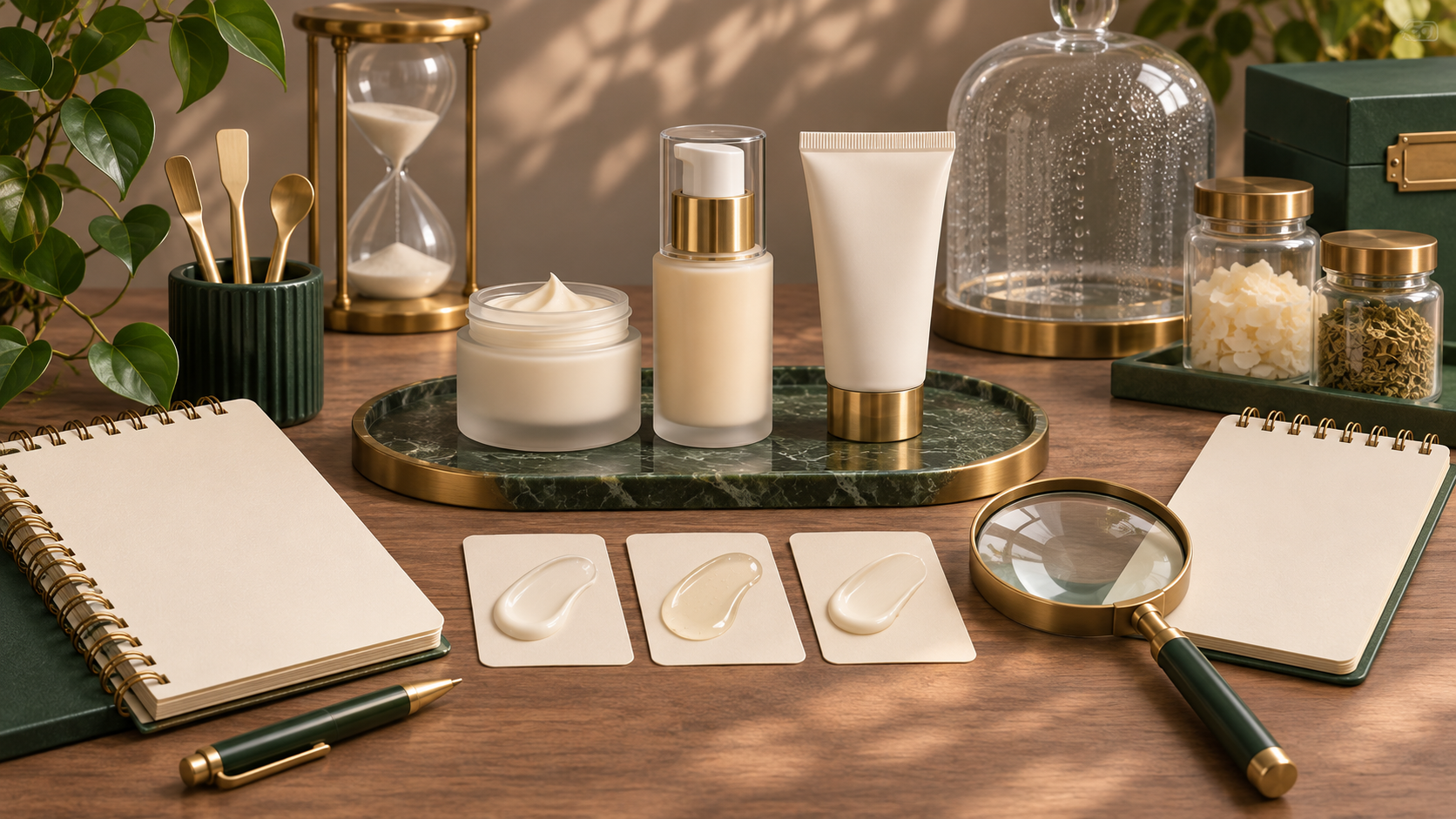
Then review the study design. The report should explain the method or approach, relevant dates and conditions, observation points, the characteristics assessed and the criteria used to interpret them. Measurements need enough context to be understood, including units where applicable. Ask which parts of the report relate to unopened storage, package function or a particular use scenario.
Look for the observations and any deviations. A deviation might mean that a sample was handled differently from the plan or that a measurement could not be taken as intended. The report should not hide that fact behind a simple summary. Ask whether the deviation affects the reliability or scope of the conclusion, who reviewed it and whether the issue remains open.
A result outside a criterion needs an explanation and a documented decision. The response may involve an investigation, a change to the product or package, further evaluation or a revised conclusion. The appropriate action depends on the finding and the risk. A brand should not pressure a laboratory to relabel an unexplained result as acceptable merely to meet a launch schedule.
Finally, read the conclusion alongside its limits. What shelf-life, durability or other decision does the report support, and under which assumptions? Does it cover the actual marketed version? Does it identify information that must be confirmed elsewhere? A report may be one input to a safety assessment and quality decision; it is not a regulatory approval or a promise that every individual product unit will perform identically.
| Report element | Question for the brand |
|---|---|
| Product identity | Is the studied formula, batch and package traceable to the proposed marketed version? |
| Study design | Are the purpose, conditions, observation points and methods clear and justified for the decision? |
| Criteria and data | Are the measurements, units, acceptance criteria and relevant observations identifiable? |
| Deviations and investigation | Were unexpected results or changes documented, reviewed and resolved where necessary? |
| Conclusion and limits | Does a qualified reviewer explain what the evidence supports and what remains uncertain? |
US and EU considerations
For the United States, FDA's general cosmetic shelf-life guidance describes how a product can change through storage and use and states that cosmetics generally do not have a legally required specific shelf life or printed expiration date. The manufacturer remains responsible for product safety. [2] This general information does not determine the obligations for an individual brand, claim or product.
US classification matters. FDA explains that intended use and claims can make a product a cosmetic, a drug or both. [8] A product that is also regulated as a drug can be subject to different stability and expiration requirements. Ask the appropriate professional to identify the product category and applicable requirements before using a general cosmetic overview as the basis for a launch plan.
For the European Union, the Commission describes a framework that includes an EU responsible person and a cosmetic product safety report before a product is placed on the market. [5] Historical Commission guidance discusses stability evidence, minimum durability and period after opening where applicable, including the relationship between the sample and marketed composition. [4] The responsible team should verify the current regulation, amendments and relevant guidance for the specific product and market.
The EU and US examples do not settle the rules for the United Kingdom or other destinations. Labeling decisions should be made for the actual jurisdiction, product and evidence. A notification, a test report or a supplier's general certificate should not be described as a blanket approval of the product or a guarantee of its shelf life.
Manage changes and monitor the product after launch
A shelf-life decision is based on stated evidence and assumptions. When those assumptions change, the brand and its technical partners need a way to identify the change and decide whether the evidence remains relevant. Establish who can propose, review and approve changes before they are made.
Changes can involve an ingredient or its source, the formula version, a manufacturing process, the production site, a container or closure, the distribution route, the label or the intended use. Not every change has the same effect. Record the proposed change and ask the qualified owner to assess the potential impact on the product, package, claims and existing studies.
Keep the connection between the approved version and the supporting evidence. A useful record identifies the previous and revised versions, the reason for the change, the information reviewed, the decision, any additional work and the date and person responsible. If an uncertainty remains, state it clearly and identify the next action. Avoid creating a record that says only “no impact” without showing what was considered.
Post-launch observations can also inform a review. A brand may receive complaints about appearance, odor, dispensing or other changes. Agree how such information reaches the relevant technical and quality teams, how it is recorded and when it requires investigation. A complaint is not automatically proof of a stability failure, but it should not be ignored because a report once showed acceptable results.
FDA's cosmetic inspection checklist discusses records, laboratory controls and retained samples as quality considerations. [9] It is guidance, not proof that every listed practice is a separately binding rule for every product. Agree on the records and samples appropriate to the project and check applicable legal obligations. This guide does not prescribe a universal retention period.
A hypothetical moisturizer and pump example
Imagine a fictional brand developing a leave-on moisturizer in a pump bottle. The team has selected a preferred sensory sample, but the pump component and formula are still being finalized. The brand wants to know what information it should request before making a durability decision. This example is conceptual; it contains no real test result, schedule or shelf-life claim.
The team first identifies the current sample version and the proposed container, pump and closure. It records the intended use, target markets and the storage and distribution assumptions known at this stage. The technical owner explains which questions relate to the formula, which relate to the pack and which require separate microbiological or safety assessment.
The proposed plan describes the samples, conditions, observations, criteria and decision owners. It identifies what evidence is available for the current version and what will remain open until the final package is confirmed. If the pump changes, the team records the change and asks whether the existing information still applies. It does not assume a new pump is automatically equivalent merely because it fits the bottle.
After observations are available, the qualified reviewer explains the findings and their limitations. The brand records any unresolved work and the decision that can reasonably be made at that stage. No participant treats the preferred sensory sample as an automatic shelf-life approval or a substitute for the other evidence needed for launch.
Questions to ask before approving the plan
Use the following questions to make the scope and responsibilities clear:
- Which formula version, sample or batch and packaging components will be assessed?
- How closely do those samples represent the product intended for sale?
- What decision will the study support, and which questions fall outside its scope?
- How were the proposed conditions, observations and acceptance criteria selected?
- Which findings are available now, and which remain pending?
- How will the team document deviations, unexpected changes or results that need investigation?
- What separate safety, microbiological, compatibility or claim evidence is required?
- Who will interpret the results and make the durability or labeling decision for each market?
- Who can access the report and supporting information, and how will confidential information be shared?
- What process will be used if the formula, package, process, market or intended use changes?
Record the answers in the project plan and update them when the product changes. A clear question list helps the brand compare proposals, but it does not replace the technical design and assessment carried out by qualified professionals.
Frequently asked questions
Is there one standard cosmetic stability test duration?
No universal duration can be inferred for every cosmetic. The approach must be justified for the specific product, package, expected conditions and decision. ISO/TR 18811's public abstract expressly says that it does not specify a single set of testing conditions or criteria. [1]
Can accelerated testing prove a fixed shelf life?
An accelerated study may provide useful information as part of a justified assessment, but there is no universal conversion in this guide from a test condition to a calendar shelf life. Ask a qualified reviewer to explain the method, assumptions, supporting evidence and limitations for the actual product.
Does a stable appearance mean that a cosmetic is safe?
No. Appearance is one possible observation. Safety, microbiological protection, relevant chemical characteristics, package compatibility and claims may require separate information and review. [3, 6] The responsible team should assess the finished product and its intended conditions of use.
Can a report for a sample be used for a changed formula or package?
It may be relevant, but the answer depends on the exact change and the evidence. Identify the tested and proposed versions, then ask a qualified person to assess the impact. Do not assume that all prior evidence automatically applies or that every change automatically invalidates every result.
Who owns the report and who can use it?
That depends on the agreement and the parties involved. Discuss report ownership, access, confidentiality and the information needed by the brand's safety or regulatory professionals before commissioning work. An invoice for a service does not by itself answer every access or ownership question.
Should a brand keep retained samples?
Retained samples may be useful for a quality or investigation plan. Ask the responsible team what samples and records are appropriate for the product, how they will be stored and who can access them. Check the applicable requirements for the actual market rather than assuming a universal retention period.
Prepare the product-specific evidence brief
Bring the formula version, proposed package, intended use, target markets and known distribution conditions to the technical discussion. Ask the responsible team to identify the decision, the evidence available and the work still needed. Keep the study and its conclusions connected to the product version that will actually be marketed.
A useful stability plan is one your team can trace: it explains what was examined, why the approach was chosen, what was observed and what the qualified reviewer concluded. That record supports a more informed shelf-life and labeling decision as the product moves from development into the market.
References
Sources checked 4 November 2026. Regulations and guidance may change; verify the current rules for the actual product and destination.
- International Organization for Standardization. ISO/TR 18811:2018 — Cosmetics: Guidelines on the stability testing of cosmetic products. Public abstract; full technical report not reviewed.
- US Food and Drug Administration. Shelf Life and Expiration Dating of Cosmetics.
- US Food and Drug Administration. Product Testing of Cosmetics.
- European Commission. Implementing Decision 2013/674/EU: Guidelines on Annex I to Regulation (EC) No 1223/2009, 25 November 2013. Historical guidance; verify current provisions.
- European Commission. Cosmetics legislation.
- US Food and Drug Administration. Microbiological Safety and Cosmetics.
- International Organization for Standardization. ISO 11930:2019 — Cosmetics: Evaluation of the antimicrobial protection of a cosmetic product. Public abstract; full standard not reviewed.
- US Food and Drug Administration. Is It a Cosmetic, a Drug, or Both? (Or Is It Soap?).
- US Food and Drug Administration. Good Manufacturing Practice Guidelines/Inspection Checklist for Cosmetics.
Developing a product of your own?
Share your brief with our team to explore formula, packaging and sampling options.
Discuss your project