

There is no single private-label skincare cost or minimum order quantity that applies to every product. A useful budget starts with a defined formula, package, order quantity, destination and scope of work. It then separates the price of finished units from development, safety work, freight, other launch expenses and the cash needed before sales begin.
A supplier may quote a minimum for the finished product while a bottle, pump or printed carton has a different minimum. A low unit price can look attractive until the brand adds the costs and commitments that sit outside that quote. Equally, a higher quotation may include services that another supplier lists separately. Compare the same scope before deciding which proposal fits your project.
This guide gives beauty brands a practical way to build a line-item budget, understand different minimums and compare order scenarios. The figures in the worked example are invented for arithmetic only. They are not a supplier quotation, a market benchmark or a promise about price, quantity or timing. Your actual numbers must come from the parties responsible for your specific project.
What does a private-label skincare project actually cost?
Think about the project in four groups. The first is work needed to prepare the product, such as samples, artwork or an agreed evaluation. The second is the cost of making and packing the ordered units. The third is the cost of getting those units to the place where your business can use or sell them. The fourth is the cash needed to run the launch, including expenses that do not belong in a manufacturing quote.
These groups are connected but they answer different questions. The cost of one finished jar helps you compare manufacturing offers. It does not tell you how much cash you must pay before the first sale, what a sales channel will charge, or whether an order will fit your inventory plan. A complete budget can show both a per-unit estimate and a payment schedule without treating them as the same number.
A one-time expense may apply to a first launch but not be repeated for an identical reorder. Other costs recur for every order, every label version or each market. Record your assumption and ask the supplier when it applies again. A change to the formula, container or artwork can create new work even if a previous version has already been evaluated.
The US Small Business Administration recommends distinguishing startup expenses and recurring costs when planning a business. Its guidance is general: it does not provide a price for a skincare launch or determine how your business should treat a specific expense. [1] Use it as a planning principle, then replace assumptions with project-specific information.
What does MOQ mean in practice?
Minimum order quantity, often shortened to MOQ, is the minimum quantity a supplier will accept under a stated offer. That description is useful only when you know what is being counted. An MOQ can refer to finished units, bulk formula, a packaging component, a printed design or a reorder. The party setting the minimum and the conditions attached to it matter as much as the number.
Finished-product and formula minimums
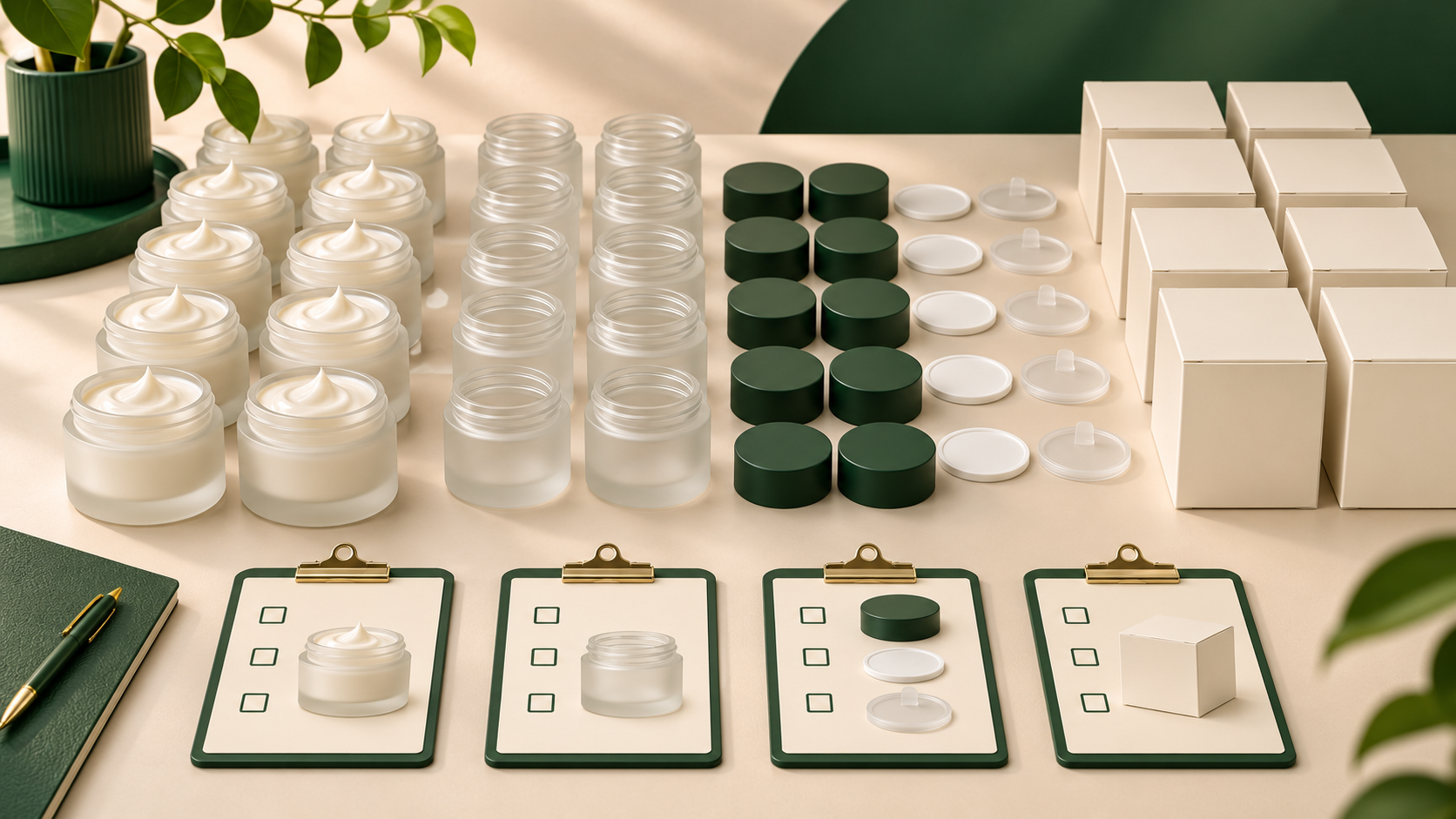
A finished-product minimum may apply to one product, one size, one formula version or one SKU. A SKU is the item your business uses to identify a specific saleable variant. If a cream has two sizes or two fragrances, ask whether the supplier treats them as one combined project or separate orders. Do not assume that the same brand name makes the products interchangeable for manufacturing.
A formula or bulk minimum may describe how much product must be made in a production run. It may be expressed by weight, volume or the number of finished units expected from the batch. Ask how the supplier converts between those measures and what assumptions it uses for filling, normal handling and any remaining bulk. A minimum batch is not necessarily a guarantee that every unit ordered will be accepted as saleable.
Request a written answer to three separate questions: how many units must be ordered, how many are expected to be produced, and how many conforming units will be accepted and invoiced. The parties should agree how to handle a difference between those amounts. Do not insert a loss allowance into your budget and also pay a separate allowance for the same loss without understanding the quote.
Packaging and decoration minimums
A bottle, closure, pump, label, carton or printed design may have its own supplier and its own minimum. A brand can sometimes share a component across variants, but this depends on fit, timing, artwork, technical approval and the relevant supplier's terms. Confirm whether a common container can be used across products and whether the artwork can differ without changing the component order.
Decoration can create a separate commitment. A printed bottle, custom color, embossing tool or outer carton may be ordered in a quantity that does not match the finished-product order. Ask whether the balance remains at the manufacturer, belongs to your brand, has storage charges, or must be paid for and shipped to you. Also ask whether the quoted minimum applies to each design or to the total across several designs.
A reorder may be subject to a different minimum, price or production condition. Record the initial order and reorder terms separately. An initial agreement is not proof that the same components, supplier or terms will be available later.
Build a complete cost worksheet
Start with the product brief and make each cost visible in one worksheet. The goal is not to predict every invoice with certainty. It is to identify what has been quoted, what remains an assumption, who is expected to pay it, and when a decision is needed.

Use a separate row for each cost rather than writing a single estimate called “factory price.” For each row, record the description, unit of measure, currency, quantity, rate, total, supplier, quote date, validity period and expected payment point. Add columns for whether the cost is included elsewhere, whether tax is recoverable for your business, and which product or market the item applies to. Ask your accountant how to treat tax and inventory in your circumstances.
The following groups are a starting point. They are possible budget lines, not a claim that every project requires each item or that a supplier charges separately for all of them.
| Budget group | Questions to put in the worksheet |
|---|---|
| Product preparation | Are sample rounds, formula changes, technical review and project management included? Which versions and deliverables are covered? |
| Evaluation and market work | What evidence, assessments, professional services and label reviews are included for the final product and destination? What remains outside the quote? |
| Packaging and artwork | Are the container, pump, label, carton, decoration, tooling, files and setup included? Are unused custom components paid for separately? |
| Finished production | Does the quoted unit include bulk formula, filling, packing, agreed inspection and a saleable finished unit? What quantity and specification does it cover? |
| Delivery to your chosen location | Which transport, insurance, export or import handling, duties, taxes and destination charges are included? Which party arranges each one? |
| Launch and ongoing operations | What storage, channel fees, marketing, administration, returns and inventory financing must the brand fund outside the supplier's offer? |
Mark each number as supplier quote, third-party quote, internal estimate or unknown. A blank is better than a confident but unsupported estimate. For a range, record the basis and the decision that would narrow it. If the project changes, keep the previous version of the worksheet so that your team can see which assumption changed.
Do not add every row blindly. If a finished-unit price already includes the bottle, label and filling, listing those items again as additional expenses would count them twice. Ask the supplier for a component breakdown or a clear inclusion list. If the supplier cannot disclose a unit-level breakdown, record the covered scope and keep excluded items separately.
Development, samples and formula work
The development budget depends on the starting point and the work agreed with the supplier. One project may evaluate an existing formula. Another may request adjustments, a new fragrance direction or additional development. The scope should state what the brand will receive at each stage and what happens if a proposed direction does not meet the brief.
Ask how many sample rounds are included, whether shipping samples is included, and what triggers an additional charge. Identify the person who consolidates feedback and the date or milestone at which a sample version becomes the basis for further work. A vague line such as “samples included” may leave unanswered whether later revisions, a second package or a change in target market is covered.
A preferred sample does not by itself establish that the final packaged product has the evidence it needs. FDA explains that companies can use relevant existing safety data and consider appropriate additional testing; it does not prescribe one test list for every cosmetic product or ingredient. [3] Ask which existing data relate to the actual formula, package and intended use, and which evaluation is still needed. A quoted sample fee should not be assumed to cover that work unless the proposal says so.
Separate development payments from rights. Paying for a sample or development project does not automatically tell you who owns a formula, who may use it elsewhere, or whether any exclusivity applies. Put ownership, access to information, permitted use and transfer conditions in the agreement and seek qualified advice when necessary. Do not treat an unspecified future right as an asset you can price today.
If your team has not selected a market, mark market-related work as provisional. A change in the intended use, claim or destination may require the responsible professionals to review the scope again. Ask the supplier how changes affect the proposal before authorizing them; do not assume that every change triggers the same evaluation or fee.
Packaging choices and component minimums
Packaging is both a product decision and a cash commitment. The container and dispenser must suit the intended formula and use, and the selected components must work with the filling and packing plan. The appearance of a sample alone does not tell you whether the proposed complete pack has been assessed for the intended project.
Ask the supplier to identify every component in the quote: primary container, closure or pump, liner where relevant, label, secondary carton and any outer shipping protection. For each component, note the specification, supplier, order minimum, available colors or decorations, and whether it is part of the finished-unit price. If artwork or a custom component has a setup cost, record that cost once and identify which design or tool it covers.
Custom tooling deserves a separate row. The agreement should identify the tool, the party that pays for it, where it is held, the conditions for maintenance, and whether the brand can use or transfer it. A tooling fee does not automatically answer ownership or access questions. Ask what happens if a different factory is needed or if the project ends before an order is placed.
Consider the cash tied up in packaging that is ordered but not yet used. If the package supplier's minimum exceeds the planned finished-product order, your team needs to know who buys the balance and whether it can be held for a future run. Include any agreed storage, handling, inspection or disposal terms. A component balance is not a saving merely because it may be useful later: it is inventory with an associated cash commitment and a risk of change.
Avoid assuming that a jar, pump, stock bottle or custom bottle is always the least expensive choice. The cost depends on the actual component, decoration, quantity, supplier and work included. It also depends on whether the design suits the formula and the intended user. Ask for alternatives using the same product brief and compare the technical and commercial consequences together.
If several products could share a bottle or carton, list the conditions. The formula may need a different closure; one version may need different label space; a design revision may make older printed components unusable. Confirm the final component specifications and required approvals before placing a combined order. A forecast helps the supplier plan, but only the accepted purchase terms establish the actual commitment.
Budget for safety, evidence and target-market work
A quotation should identify the work needed for the actual product and market, the party responsible for it, and the evidence or report to be delivered. This can include review of ingredients and finished-product safety, stability or microbiological questions, packaging suitability, claims support, label preparation and professional assessment. The necessary scope varies; a universal test package or price cannot be inferred from the product category alone.
Ask whether an existing report covers the exact formula version and intended package, who commissioned it, what conditions and results it describes, and whether your responsible specialists can access it. A report from a different version may still be useful, but a qualified person must decide its relevance. If a test or assessment is excluded from the supplier's quotation, obtain a separate scope and cost rather than assuming the work is optional.
United States: identify the product and the responsible parties
In the United States, the product's intended use and claims affect whether it is regulated as a cosmetic, a drug or both. FDA describes examples in which a product has more than one regulatory category. [4] A budget for an ordinary cosmetic cannot be assumed to cover additional requirements that may apply to a product with drug claims or an active function regulated as a drug. Review the proposed use and claims before requesting a final scope.
The Modernization of Cosmetics Regulation Act of 2022, or MoCRA, addresses areas including safety substantiation, facility registration, product listing and serious adverse-event reporting. FDA describes exemptions for certain small businesses and circumstances in which those exemptions do not apply. [2] The correct treatment depends on the entities, facilities and product. Do not assume that a small brand is exempt from every obligation, or that a registration or listing is FDA approval.
For budgeting, identify who will provide the necessary information, who will carry out an assigned task, whether a professional service is needed and how updates will be handled. A contract can allocate work between parties, but it does not erase a legal duty that applies to a particular responsible person or facility. Obtain advice for the specific project.
European Union: separate the portal from the work behind it
The European Commission describes an EU responsible person and a cosmetic product safety report as part of the EU framework. [5] A brand planning an EU launch should determine the relevant roles and the information needed for the safety assessment and product file. Ask what the manufacturer can provide, what must come from other suppliers, and what a qualified assessor needs for the final product.
The EU Cosmetic Products Notification Portal, or CPNP, is a free notification system. The Commission states that responsible persons and, in certain circumstances, distributors submit product information through it. [6] The portal's free access does not mean that an independent safety assessment, responsible-person service, translation or preparation of the underlying information is free. Include only the services your project actually requires and use real quotations for their cost.
Notification should not be described as product approval. EU information in this guide is not a substitute for checking the current rules for the actual formula, claims and market. The United Kingdom and other destinations must be assessed under their own applicable requirements.
Claims and artwork need their own scope
List the claims your brand plans to use on the package, product page and advertising. Match the proposed statement to the evidence available for the finished product and intended conditions. Ingredient information alone does not automatically prove a finished-product performance claim. Ask who will review claims, which evidence can be shared, and whether additional work is proposed.
Environmental claims also need a defined basis. The US Federal Trade Commission cautions against broad, unqualified environmental-benefit claims and explains that claims should be clear and supported. [10] A packaging description should reflect the actual components and conditions rather than assuming that every buyer can recycle or refill the complete pack. Budget for review where the claim is part of the launch; do not invent a fixed test or fee.
Freight, customs and landed costs
A production quote and a delivered cost are not necessarily the same. The brand needs to know where the supplier's responsibility ends, which location is named, who arranges transport, and which charges are included in the quoted amount. Record the answers even when the supplier offers to coordinate freight, because a coordinated service may still contain separate invoices or exclusions.

Create rows for the actual route and agreement. Depending on the project, these can include collection, export handling, freight, insurance if arranged, import handling, duties, applicable taxes and delivery to a warehouse. Obtain quotes or estimates from the responsible provider and record the destination and validity period. Do not enter a duty rate or tax amount from an unrelated product or market as if it were confirmed.
An Incoterms rule and its named place can help the parties describe certain delivery obligations, costs and points at which risk transfers. Different rules allocate these matters differently. Confirm the exact rule, version and named place in the commercial agreement, then ask which charges remain outside the quote. [7] A location name without the relevant rule may not answer who arranges a particular step.
Incoterms do not by themselves decide every aspect of a sale. ICC guidance distinguishes the delivery rules from issues such as payment, ownership transfer, governing law and dispute resolution. [8] Address those matters in the agreement and ask qualified advisers how the terms apply. Do not infer that a supplier's quoted delivery term settles customs classification, product compliance or the treatment of a tax in your accounts.
Use the term landed cost consistently in your own worksheet. Businesses can use it differently, so write down which costs your calculation includes. For this guide, the example below includes the identified finished units, one batch-specific evaluation charge and specified nonrecoverable destination costs. It does not include marketing, general overhead or one-time development costs in the per-unit figure. That is a planning choice, not a required accounting treatment.
Calculate unit cost and cash needs without double counting
First decide the denominator. If your planning question is the cost per unit you can actually sell, use the number of saleable units expected at the point defined in your worksheet. A produced unit that fails the agreed acceptance criteria or a unit reserved for samples may not be available for sale. Estimate those quantities transparently and update the calculation when actual accepted quantities are known.
Next identify the numerator. Add the costs that your definition assigns to that batch: for example, the quoted finished units, a separately quoted batch-specific service and nonrecoverable delivery charges not already included in the unit price. Keep recoverable taxes, financing costs and general operating expenses in clearly marked rows unless your agreed accounting method includes them. Have an accountant review the method before using it in financial reporting or tax decisions.
The planning formula is:
Estimated batch cost per saleable unit = eligible batch-specific costs plus attributable nonrecoverable destination costs ÷ saleable units.
Then decide how to present one-time launch costs. One view can show them separately so the team sees the cash required to start. A second view can allocate those costs across an explicitly stated number of units or orders for an internal planning comparison. Show the allocation rule and do not pretend that the resulting number is the supplier's unit price. If future reorders are uncertain, do not spread the launch cost over an invented future volume and present that as a confirmed saving.
Cash timing is a separate calculation. List deposits, balances, service invoices, shipping payments and other launch expenses in the periods when they are due. Include amounts due before a supplier delivers the goods and amounts due before a marketplace or customer pays you. An order can have an acceptable estimated unit cost and still require more cash upfront than the brand can safely commit.
Check each entry for duplication. If a freight quote includes insurance, do not add the same insurance amount again. If an assessment fee covers multiple products, specify the allocation rather than charging the full invoice to each one. If a supplier offers a credit for a sample fee against a later order, record the credit only after the supplier confirms the conditions and the credit is applied.
Worked example: compare a batch cost with the launch cash requirement
The following example is entirely hypothetical. The quantities and dollar amounts are invented to demonstrate the calculation. They are not a quote from YOUREE or any supplier and should not be used as a market price, typical MOQ or expected lead time.
Assume a brand plans one fictional skincare product in one package and expects 2,400 saleable units. The supplier's fictional quote for finished units is $3.60 per unit. In this example that unit price already includes the formula, container, closure, label, filling and packing described in the agreed specification. The brand must pay a separate $760 batch-specific evaluation and $900 in freight and handling. The example also assumes $240 in nonrecoverable import charges. These items are mutually exclusive: none is already included in the $3.60 unit price.
| Hypothetical batch item | Calculation | Amount |
|---|---|---|
| Finished units | 2,400 × $3.60 | $8,640 |
| Batch-specific evaluation | Separate assumed charge | $760 |
| Freight and handling | Separate assumed charge | $900 |
| Nonrecoverable import charges | Separate assumed charge | $240 |
| Total included in batch-cost calculation | $8,640 + $760 + $900 + $240 | $10,540 |
| Estimated cost per saleable unit | $10,540 ÷ 2,400 | $4.3917, or about $4.39 |
In this example, the $4.39 figure is a rounded internal estimate under the stated definition. It is not the supplier's $3.60 unit price. It also excludes the separate launch expenses and operating expenses described below. Keep the unrounded calculation in the worksheet so that later totals are not distorted by repeated rounding.
Now assume the same fictional brand has $1,800 in one-time launch preparation and $300 in sample-related costs, neither of which is included in the batch lines above. The cash for these specified items plus the batch is $12,640: $10,540 + $1,800 + $300. This is not the brand's complete startup budget. It excludes any costs not listed, such as website, insurance, storage, marketing, payment fees, financing or tax that may apply to the real business.
Suppose the fictional manufacturing agreement calls for a 40% deposit on the $8,640 finished-unit quote and the remaining 60% before delivery. The deposit would be $3,456 and the balance $5,184. Those two payments total $8,640; they are not additional costs on top of the $8,640 already counted. The other fictional items remain due at their own agreed times. Put those dates or milestones in the cash schedule after the providers confirm them.
Finally, test the denominator. If the same $10,540 of identified batch costs remained payable but only 2,250 units were saleable, the estimated batch cost would be $4.6844 per saleable unit, or about $4.68. This is a sensitivity calculation, not a prediction that 150 units will be lost or that the supplier will charge for nonconforming units. The contract, cause of the shortfall and actual invoices determine what the brand must pay. The example simply shows why both the cost total and the saleable-unit count need clear assumptions.
Do not infer profit from the batch cost alone. Selling fees, returns, fulfillment, promotion, operating costs and taxes may materially change the result. If you calculate gross margin or markup, define the revenue and costs included and use the same definition across scenarios. A spreadsheet can organize the decision; it cannot guarantee demand or the final commercial outcome.
Compare order quantities, stock and cash together
Ask for a small set of quantity scenarios using the same formula, package, market and scope. A useful comparison includes the quoted unit price, separate setup or development amounts, total order commitment, payment schedule, expected saleable units and delivery assumptions for each option. Ask the supplier to identify any differences in included work rather than assuming the offers are identical.
A larger order may spread an agreed setup charge across more units or qualify for a different quoted price, but neither outcome is automatic. The supplier's actual proposal controls the calculation. Even if the estimated unit cost falls, the brand may need more cash, more storage and more time to sell the stock. Compare the total exposure as well as the per-unit figure.
Inventory has practical limits. Product condition can change with storage and use, and FDA notes that factors such as contamination and changes in the formula can affect cosmetic shelf life. [9] Ask which storage conditions and evidence apply to the actual product, how stock will be rotated, and what information the responsible team has about the proposed shelf life. Do not enter a universal expiry period for every cosmetic or assume that a test on an earlier version covers the final product.
Consider the consequences of a slow launch. Which costs remain if the first order sells more slowly than planned? Can a printed component be used for a later order, and under what conditions? What happens if the brand needs to change an ingredient, claim, label language or destination? A lower initial cash commitment may reduce one risk while creating a higher per-unit cost or a later reorder constraint. Show both effects rather than using one number as the sole decision rule.
A reorder scenario also needs a documented assumption about component availability, minimums and the period in which the supplier's quotation is valid. A previous purchase does not guarantee a future production slot, price or lead time. Ask for the latest terms before relying on them in a launch plan.
Request comparable quotes and negotiate scope
Send each supplier the same version of the brief. Include product format and intended use, confirmed destination, desired claims, formula starting point, package components, proposed quantity, required documents and target delivery location. Identify the requirements that are mandatory and the points on which your team is willing to consider alternatives. Share confidential information only through an agreed, suitable process.
Ask each supplier to state its legal entity, the site or parties expected to carry out the work, the quote currency, the period of validity and the quantity to which the price applies. Request a list of included and excluded activities. If the supplier proposes a different package, formula route or assessment scope, record the difference. Two prices are not directly comparable if one includes a finished, labeled unit and another covers bulk product only.
For each proposal, ask the supplier to identify:
- The formula, package, artwork and specification versions used for the quote.
- Minimums for the finished SKU, bulk formula, each custom component and any reorder.
- Sample rounds, technical reviews, reports and market-related services included or excluded.
- Production price, setup, tooling, component balances and any separate storage or handling costs.
- Payment milestones, currency, taxes, quote validity and the process for approving changes.
- The delivery rule and named place, plus the transport, insurance, customs and destination costs outside the quote.
- The decision process if materials, artwork, quantity, schedule or the target market change.
A negotiation should make the trade-off clear. For example, you can ask whether an agreed stock component changes the setup cost, whether variants can share a component, or whether a development task can be separated into a later decision. The supplier may accept, decline or propose conditions. Record the answer in the revised offer; an informal discussion is not a confirmed reduction or a change to the technical scope.
Before approving a purchase, reconcile the quote with the budget worksheet and cash schedule. Have the responsible technical and regulatory people review the final formula, package, claims and documentation plan. Confirm who can authorize an added cost and how the parties will handle a disagreement about a deviation or change. A well-defined proposal gives both sides a clearer basis for the next decision.
Frequently asked questions
Is there one standard MOQ for private-label skincare?
No single minimum can be assumed. Ask each supplier what its stated quantity measures and whether separate minimums apply to the finished SKU, formula batch, packaging components, decoration and reorder. Obtain the conditions in the written proposal for your actual product.
Does the finished-unit price include packaging?
It may or may not. Ask for an inclusion list covering the container, closure or dispenser, label, carton, filling, packing and any required setup. If those items are included, avoid adding them again to the project budget. Treat a separate custom-component commitment as its own line if it is not included.
Are safety assessments and tests included in a private-label quote?
The quotation must say what work and evidence it covers. Ask which version and package an existing report concerns, who can access it, and what the responsible specialists identify as outstanding. A quotation for samples or production does not automatically include every assessment needed for a specific destination and claim.
How should a brand calculate its effective cost per unit?
Define the cost categories first, then divide the included costs by the number of saleable units used in that scenario. Keep one-time launch expenses visible and explain any allocation across units or orders. Use actual quotes and invoices as they become available, and seek accounting advice for financial reporting and tax treatment.
Why can a low quoted price still lead to a high launch budget?
The price may cover only part of the work, or the order may require deposits, custom components, evaluation, freight and other spending before sales begin. A lower price can also come with a larger quantity commitment. Compare the complete scope, the cash schedule and the inventory exposure rather than judging the unit rate alone.
What information should a first project brief contain?
Describe the product format, intended use, target customer, destination markets, desired claims, formula starting point, package direction and expected quantities. Include any target cost or timing as a planning objective, not an agreed supplier commitment. Mark unknowns and ask which details are needed for a reliable proposal.
Prepare a project-specific budget
Start with one clear product brief and a worksheet that separates confirmed quotes from assumptions. Identify the minimum for each relevant part of the order, the work included in the finished-unit price, the remaining evidence and market tasks, and the cash needed at each payment milestone.
Use that information to request a project-specific proposal and compare the same scope across suppliers. Update the worksheet as the formula, package and destination become clearer. The aim is a budget your team can explain and revise, supported by the actual agreements and evidence for the product you intend to launch.
References
Sources checked 4 November 2026. Rules and guidance may change; verify current requirements for the actual product, parties and destination.
- US Small Business Administration. Plan your business.
- US Food and Drug Administration. Modernization of Cosmetics Regulation Act of 2022.
- US Food and Drug Administration. Product Testing of Cosmetics.
- US Food and Drug Administration. Is It a Cosmetic, a Drug, or Both? (Or Is It Soap?).
- European Commission. Cosmetics legislation.
- European Commission. Cosmetic product notification portal.
- International Chamber of Commerce. Incoterms and commercial contracts: Q&A, Incoterms 2020.
- ICC Academy. Incoterms 2020: new rules, old problems.
- US Food and Drug Administration. Shelf Life and Expiration Dating of Cosmetics.
- US Federal Trade Commission. Environmental Claims: Summary of the Green Guides.
Developing a product of your own?
Share your brief with our team to explore formula, packaging and sampling options.
Discuss your project