
Private label, original equipment manufacturing (OEM), and original design manufacturing (ODM) are useful starting points for a conversation with a cosmetics supplier. They do not, on their own, tell you who owns a formula, how much you can change, which tests are included, or who is responsible for a product in your target market. Those details belong in the project scope and agreement.
As a practical guide, private label often means selling a supplier's existing product under your brand. OEM often means a manufacturer produces to a customer's specifications. ODM often describes a supplier developing or adapting a product that a customer sells under its brand. Suppliers use these terms differently, and a project can combine all three approaches. Ask each supplier to describe the work behind its label before comparing offers.
The right choice depends on the product you want to create, the control you need, the evidence your market requires, and the resources you can commit. An existing formula may be a sensible way to assess demand. A custom development project may suit a brand with specific product requirements. Neither approach automatically provides exclusive rights, regulatory compliance, or a particular price or launch date.
This guide explains the decisions behind each model, from the first brief to production and ongoing control. It is written for beauty brands and purchasing teams comparing manufacturing partners across markets. The regulatory sections are an introduction to selected US and EU considerations, not a complete market-entry assessment.
Why the model name is only the beginning
It is easy to compare a short list of suppliers by asking, “Do you offer OEM or ODM?” The answer may help you find a starting point, but it cannot replace a written scope. One supplier may use “OEM” for a customer-owned formula. Another may use it for a supplier formula with a custom label. A third may call the same combination “private label.” There is no reliable way to infer every supplier's commercial terms from the acronym alone.
Instead, separate your decision into four questions:
- Product starting point: Is the formula existing, adapted, newly developed, or supplied by your team?
- Scope of work: Who develops, evaluates, sources, fills, packs, stores, and ships each part of the product?
- Rights and access: Who owns or may use the formula, packaging design, testing results, and production records?
- Responsibilities: Who makes decisions, approves changes, handles complaints, and meets obligations in each market?
Ask each supplier to answer the same questions for the same product brief. Only then compare the model names and quotations. A detailed proposal lets you see whether two offers cover equivalent work or leave different tasks for your team.
What is private label cosmetics manufacturing?
In common commercial use, private label means a brand sells a product under its own name while another business supplies or manufactures it. The starting product may already exist in the supplier's range, although the available level of customization varies. The brand may be able to select a package, add artwork, choose a fragrance, or request other changes if the supplier agrees.
For example, a retailer might evaluate an existing body lotion, select a suitable container, and create its own label. The supplier may retain ownership of the underlying formulation and offer it to other customers. Alternatively, the parties may agree on adjustments or some form of exclusivity. Neither arrangement follows automatically from the term “private label.”
An existing formula can reduce the amount of development that a project needs, but the actual route still depends on the product and market. A formula used in one market may need further review for a different destination. A change to fragrance, a new container, or a different product claim can also change the questions that need to be answered. Ask what prior evaluations cover, whether they apply to the exact version and package, and what additional work remains.
Private label is worth considering when the desired product experience is close to an available option and the brand accepts the agreed limits on customization and rights. It may be less suitable when a distinctive formula, detailed control over ingredients, or freedom to move production between manufacturers is essential. These are trade-offs to confirm with a supplier, not fixed rules for every private label offer.
What does OEM mean in cosmetics?
OEM is commonly used for a manufacturing arrangement in which a supplier produces a product to a customer's specifications. The customer may bring a formula, packaging design, technical requirements, or another defined starting point. The manufacturer then reviews whether the proposed product can be made on the relevant equipment and under the agreed quality plan.
The customer's starting materials can vary. A brand may own a formula with documented manufacturing instructions. It may instead own a product brief but need help turning it into a workable specification. In the second case, the supplier's development contribution and the rights arising from that work must be defined. Calling the project OEM does not answer those questions.
If you bring a formula, prepare to discuss the information the manufacturer needs to assess it. An ingredient list alone may not explain the order of addition, processing temperatures, mixing requirements, raw-material specifications, or finished-product acceptance criteria. Some information may be confidential. Agree on suitable confidentiality arrangements and a secure method for sharing it before sending a complete formula.
Also discuss manufacturing transfer. A formula that has worked in a laboratory or at a different facility still needs a review of the proposed materials, equipment, batch size, packaging, and process. Agree on trial work, acceptance criteria, and who pays for a change if a scale-up issue appears. The aim is to establish a workable production plan, not to assume that a formula can be transferred without evaluation.
OEM can be a useful model when your team has specifications and wants a manufacturing partner to execute them. It can also require more coordination from the brand if several parties supply the formula, ingredients, packaging, and testing. Ask who manages the interfaces between those parties and who resolves conflicting instructions.
What does ODM mean in cosmetics?
ODM often describes an arrangement in which a supplier contributes to the design or development of a product for a brand. That work may start from an existing formulation, a supplier's technical platform, or a product brief. The supplier may propose a formula direction, produce samples, source packaging, and help prepare a production specification, depending on the agreement.
For a buyer, the important distinction is the scope of the development work. “Develop a serum” can mean selecting an existing base and changing its fragrance. It can also mean creating and evaluating a new formula against a detailed set of requirements. Those projects differ in work, information needs, cost, timing, and ownership. Ask for each stage and its deliverables in writing.
A development proposal should explain how many sample rounds are included, what feedback the supplier needs, and what happens if the requested product cannot meet the agreed objectives. It should also describe which evaluations are included, which are separate, and which apply to the final formula in its intended package. The parties should document the sample version that each decision refers to.
ODM can suit a brand that wants technical input during development. The trade-off is that the supplier's contribution may create questions about background know-how, new intellectual property, and continued access to the formula. Resolve those questions in the contract. Paying for development alone does not establish what a brand may disclose, transfer, or manufacture elsewhere.
Private label, OEM, and ODM compared
The following table describes common starting points, not fixed definitions or promises. A supplier's proposal may combine features from several columns.
| Decision | Private label: common starting point | OEM: common starting point | ODM: common starting point |
|---|---|---|---|
| Product concept | An existing supplier product or range | A customer's product specification or formula | A brief developed with supplier input |
| Formula work | Selection or agreed changes | Production to an agreed formula or specification | Supplier-led development or adaptation as agreed |
| Brand involvement | Selection, artwork, approvals, and market requirements | Specifications, approvals, and coordination | Brief, feedback, approvals, and agreed development decisions |
| Rights | Depend on the agreement | Depend on the agreement | Depend on the agreement |
| Testing and documentation | Confirm coverage for the final product and market | Define who provides and reviews each item | Define what development includes and what needs separate work |
| Best question to ask | What exactly can we change and use? | Is our specification ready to manufacture? | What will be developed, delivered, and licensed? |
An offer may use an existing formula, involve supplier development, and be produced to a customer-approved specification. The table is therefore a way to organize questions, not a way to label a supplier as inherently better. Ask for a work breakdown and use that breakdown to compare like with like.
How to choose a manufacturing model
Start with the business decision the product must support. A brand testing a new category may value a clear initial scope and manageable commitments. An established range may place more weight on a specific sensory profile, control of an ingredient supply, or continuity between factories. Neither business can choose well without understanding what it will receive and what it must supply.
1. Define the product and the target market
Write down the product format, intended use, target customer, destination market, package, and claims you hope to make. Separate requirements from preferences. For example, a particular closure may be essential to the way the product is used, while a particular decoration may be negotiable. This distinction gives suppliers a basis for recommending alternatives without changing the core brief.
Tell suppliers where the product is intended to be sold before asking for a final quote. Requirements vary between markets, and the same marketing claim can affect how a product is classified. If you are still choosing markets, state which are confirmed and which remain possibilities. Ask what a market change would mean for ingredients, testing, labels, and documentation.
2. Decide how much product development you need
Evaluate whether the product objective could be met with an existing formula, an adjusted formula, or a new development project. The answer should come from sample evaluation and the project requirements, rather than an assumption that one route is always more original or less expensive. A brand may create a distinctive offering through its package and positioning even when its formula is not exclusive. Another may require specific technical work that an existing option cannot provide.
Ask for a clear description of the starting formula and the work required to reach the proposed version. “Customizable” should be followed by a list of changes that are available, their limits, and any effect on evaluation or cost. Record which changes need a new sample, technical review, or written approval.
3. Set a realistic control and rights requirement
List what you need to control during development and after launch. This might include approving ingredient substitutions, reviewing changes to packaging components, receiving a defined set of records, or having the right to transfer the product to another manufacturer. Rank the items that are essential to your business.
Control has a practical dimension as well as a legal one. A contract might grant a transfer right, but the team also needs the information required to exercise it. Ask what formula, process, raw-material, supplier, and testing details would be available, in what form, and under what conditions. A right that cannot be used without missing information may not achieve your continuity objective.
4. Compare total project costs and commitments
Request quotations against the same brief and compare the work included in each. The price per finished unit is one part of the picture. Development, samples, evaluation, tooling, packaging, transport, duties, storage, and artwork changes may be quoted separately. Ask about taxes, payment terms, and any costs associated with a change or cancellation.
Minimum order quantity, often called MOQ, may apply to the finished product, the bulk formula, an individual packaging component, or a printed design. A finished-product minimum is not necessarily the same as a supplier's minimum for a custom bottle. Ask whether several products or variants can share components, and confirm any conditions in the quote. There is no universal MOQ for these models.
Timing also depends on the work. Supplier review, sample feedback, component availability, evaluation, artwork approval, and production scheduling all affect a project. Ask for a schedule with assumptions, dependencies, and approval points. A date given before the scope is clear should be treated as a planning estimate rather than a guarantee.
Formula ownership, exclusivity, and the right to change suppliers
Questions about intellectual property are often postponed until after a sample is approved. That can be costly if the brand discovers that the supplier's standard terms do not match its expectations. Discuss ownership and use before commissioning work, and have qualified counsel review the agreement in the relevant jurisdictions.
Separate the formula from the finished product
Buying finished units does not necessarily transfer the formula. Equally, paying a development fee does not by itself establish that the brand owns all underlying materials or has unlimited rights to manufacture elsewhere. Ask the supplier to distinguish its pre-existing formula, methods, and know-how from new work created for the project. Specify the rights granted to each party and the conditions attached to those rights.
If a supplier needs to keep a formula confidential, discuss how the brand and its appointed safety or regulatory professionals can receive enough information to complete their work. Depending on the parties and the market, a direct confidential disclosure to an assessor may be one option. Agree on the actual arrangement rather than assuming that an ingredient list will always contain everything needed for a safety assessment.
Define exclusivity precisely
“Exclusive formula” can mean several things. Does the restriction apply to the full formula, an ingredient combination, a fragrance, the package, or a particular claim? Does it cover every market and sales channel, or only an agreed territory? Is it permanent or limited to a period? Does it depend on purchase volumes or continued payment? What happens if the brand does not launch?
Put the answers in writing. A useful clause also identifies permitted existing customers, variations, remedies, and what evidence each party can review. Avoid assuming that a unique label makes the contents exclusive, or that exclusivity in one country automatically applies elsewhere.
Plan for continuity
Ask what happens if a raw material is discontinued, a facility changes, or the relationship ends. Identify who can approve a substitute, which records must be retained, and what information the brand can access. If the right to move production matters, discuss technical transfer, confidentiality, outstanding fees, and responsibilities for existing stock.
An exit plan need not imply a lack of trust. It gives both parties a way to protect product continuity if circumstances change. Review the plan alongside the quality agreement so that rights, records, and practical handover steps support one another.
From brief to production: the decision gates
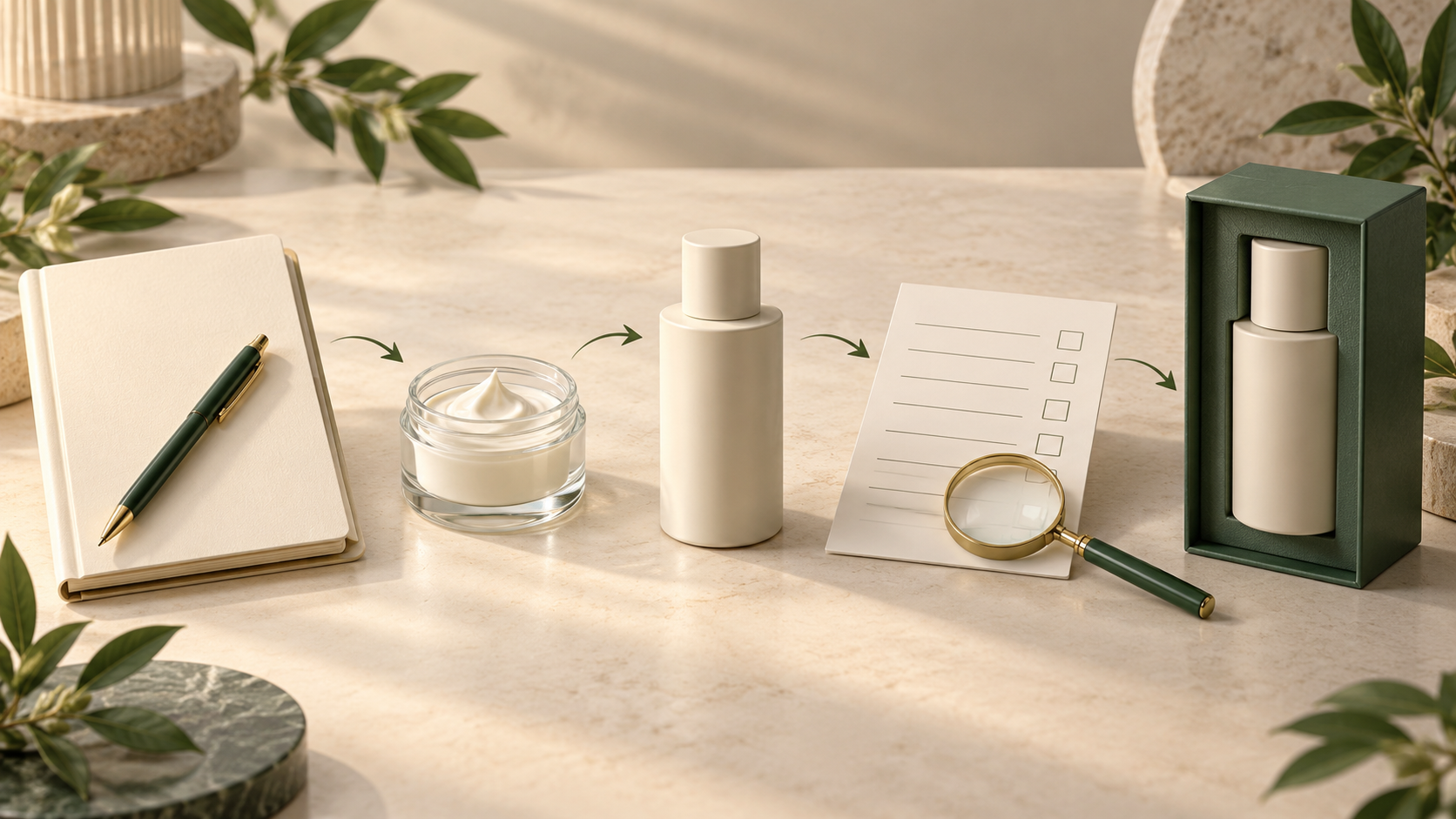
Whatever the commercial model, a cosmetics project benefits from clear decisions at each stage. The sequence below is a planning framework; the actual order and the work needed will depend on the product, market, and agreement.
Gate 1: Agree on the brief and scope
Share the product type, intended use, market, target customer, desired experience, packaging direction, expected quantity, and any target cost or launch window. Mark assumptions that are not yet confirmed. Give suppliers the same core information so their proposals can be compared.
Ask each supplier to identify what it will provide and what your team must arrange. A useful response separates development, samples, manufacturing, packaging, testing, regulatory support, and delivery. Confirm whether the supplier will perform a task itself or coordinate another party. Agree on a contact for technical decisions and a process for approving changes.
Decision: Is the proposed starting point suitable, and are the scope, exclusions, estimated costs, and next steps clear enough to commission work?
Gate 2: Evaluate and record the sample
Agree on what the sample needs to demonstrate. Review appearance, scent, feel, dispensing, and use against the brief where relevant. Capture observations separately so that the supplier can understand the requested change. For instance, “reduce the oily feel after application” is more actionable than “make it better.”
Record a unique sample reference and the date of feedback. If the formula, fragrance, or package changes, identify the new version. A preferred sample is an important decision, but its approval does not replace the other evaluations required for the final product and intended market.
Decision: Does the identified sample meet the agreed product objectives, and is there a written plan for unresolved technical questions?
Gate 3: Confirm the formula and package together
The product includes both the contents and the package that protects and delivers them. Confirm the container, closure, dispenser, fill volume, contact materials, decoration, and outer pack as applicable. Discuss the proposed evaluation of the formula in its intended packaging, including storage, dispensing, sealing, and any compatibility concerns relevant to the product.
A new bottle or pump may change how the product is stored or used. A package that works for one formula cannot automatically be assumed suitable for another. FDA notes that cosmetic shelf life depends on product type, use, and storage, and that changes such as contamination or separation can affect a product over time. [8] Agree on the testing plan and what happens when a result fails or a component changes.
Decision: Are the formula version, package components, specifications, test plan, and outstanding risks identified and accepted by the responsible parties?
Gate 4: Review claims, evidence, and market documents
List every product claim intended for the label, website, advertising, and other sales material. Match each claim to evidence for the relevant finished product and use. An ingredient study can help explain a formulation choice, but it does not by itself prove that the finished product produces the same effect. Review the formula, proposed claims, labels, and documents with qualified professionals for the intended markets.
Check what the supplier will provide and who can access it. Request a list of completed evaluations, their methods, the samples tested, and any limits. If an important item is absent, decide whether additional work is needed before production or launch. A document title alone does not establish that its conclusions apply to your exact formula and package.
Decision: Is the evidence and documentation plan appropriate for the final product, claims, and destination, and are the remaining approvals assigned?
Gate 5: Release production and manage change
Before production, identify the approved formula, packaging specifications, artwork, manufacturing site, inspection points, and release criteria. Agree on the documents needed for each batch and the process for recording deviations. A deviation is a departure from an agreed requirement or procedure; the parties should agree who evaluates it and who can authorize a disposition.
After production, retain the records required by the contract and applicable law. Agree how the supplier will notify the brand about a proposed change to a material, process, site, or component. A seemingly small substitution can affect the specifications or evidence on which an earlier decision relied.
Decision: Have the required checks and approvals been completed, and is the batch ready for release under the agreed plan?
Quality and testing: what should the brand ask?
A model name is not a quality system. Whether you select an existing formula or develop a new one, ask how the proposed manufacturer controls raw materials, water where relevant, equipment, personnel hygiene, production records, and finished-product checks. FDA's cosmetics GMP inspection checklist identifies areas including buildings, equipment, personnel, raw materials, production, laboratory controls, and records as subjects for review. Its checklist is guidance and should not be presented as a certificate or as a complete description of every applicable obligation. [3]
Request a risk-based explanation of the testing proposed for your product. The appropriate work depends on the formula, packaging, intended use, and market. It may involve reviewing stability, microbiological risk, preservative effectiveness, package compatibility, and other properties. Ask who selects the methods, whether a qualified internal or external laboratory performs the work, and how results will be interpreted. Avoid treating a fixed list of tests as suitable for every product.
Microbiological contamination is a specific concern for cosmetics. FDA explains that harmful microorganisms can make a product unsafe and describes routes by which contamination may occur. [4] Ask how the supplier assesses contamination risks during production and how the product is expected to remain suitable through its intended use. A positive discussion should cover both the manufacturing process and the finished product's design; a single attractive marketing claim is not evidence of either.
Certificates can be useful documents, but they need context. Check the issuing organization, certificate holder, facility, scope, issue and expiry dates, and current status where an independent verification route exists. A facility certificate is not automatically approval of each product or proof that a particular claim is substantiated. If the work will take place at a different site or a subcontractor, request information for the actual operation.
Understanding costs, MOQ, and lead time
Ask for a cost breakdown that follows the decisions you will make. A quote can distinguish development, sampling, testing, formula or bulk production, filling, components, decoration, packing, freight, and other agreed services. It should identify any assumptions about quantities, materials, artwork, and delivery terms. If a supplier offers a low unit price, check which activities or fees are outside that price before comparing it with a more inclusive offer.
The MOQ can be driven by more than the filling process. A particular pump, printed carton, decoration method, or raw material may have its own ordering requirement. If demand is uncertain, discuss what alternatives exist: a standard component, fewer variants, shared components, or a staged project. Each alternative has consequences for appearance, stock, and control. Confirm what the supplier can actually offer for your brief.
The total timeline also has several paths. Packaging artwork may progress while a sample is under review, but a final label cannot be approved responsibly before the necessary product and market information is available. An evaluation may need time under defined conditions. Supplier capacity and component supply may change. A useful schedule shows the tasks that can run together and those that depend on a prior approval.
For every estimate, ask what could change it. Clarify sample charges, evaluation fees, rework, minimum purchases, storage, delivery responsibilities, and the treatment of unused materials. Request written confirmation once the final scope is known. Avoid making commitments to customers or distributors solely on the basis of an early, conditional estimate.
US and EU requirements: what to discuss early
The manufacturing model does not decide whether a product can be sold in a market. The applicable rules depend on the finished product, claims, roles, and destination. Confirm requirements with qualified regulatory professionals and the relevant authorities before launch. The following points are a starting framework, not an exhaustive checklist.
United States: classification, MoCRA, and labeling
In the United States, intended use is central to whether a product is regulated as a cosmetic, a drug, or both. FDA explains, for example, that certain intended uses or claims can cause a product to fall under drug requirements as well as cosmetic requirements. [2] A brand should therefore review claims before assuming that a product sold by a cosmetics supplier can be marketed as a cosmetic alone.
The Modernization of Cosmetics Regulation Act of 2022, or MoCRA, added requirements and authorities relevant to cosmetics. Depending on the product, facility, and responsible party, these include areas such as facility registration, product listing, safety substantiation, and serious adverse-event reporting. FDA describes exemptions for certain small businesses and conditions where exemptions do not apply. Do not assume an exemption or assign a duty solely from the words “private label,” “OEM,” or “ODM”; identify the actual entities and confirm the applicable rules. [1]
FDA's labeling summary describes requirements affecting cosmetic labeling, including the declaration of ingredients and other information. [9] Ask who will prepare and review the final label and who will supply the information needed to do so. Claims on a website and in advertising also need review alongside the physical package. If the product is also a drug, additional requirements can apply.
European Union: responsible person, safety, and notification
For the EU, Regulation (EC) No 1223/2009 is the main framework for finished cosmetic products placed on the market. The European Commission describes the need for an EU responsible person and a product safety report before a cosmetic product is placed on the market. [5] Identify the responsible person for the actual product and agree how the necessary information will be supplied and maintained. A manufacturer located outside the EU is not automatically the EU responsible person merely because it makes the product.
The EU Cosmetic Products Notification Portal, or CPNP, is the central online system used for product notifications under the regulation. The Commission states that responsible persons and, in certain circumstances, distributors submit information through it. [6] Notification is a distinct step from the safety assessment and other obligations; it should not be described as an approval of the product.
Ask a qualified EU professional to assess the exact product, claims, ingredients, labeling, and documentation. Identify who will maintain the product information and who will review changes after launch. The EU and US frameworks use different terminology and processes. Work for one market may be useful in another, but it should not be assumed to complete the other market's requirements.
Claims about environmental benefits
If your packaging or product will be promoted as environmentally beneficial, define the claim and the evidence behind it. The US Federal Trade Commission's Green Guides caution against broad, unqualified environmental benefit claims and emphasize clear, specific qualifications. [7] A recyclable component, for example, should be described accurately within the conditions and evidence that apply. Review claims for the actual market and avoid making a broad promise based on a single material characteristic.
Three example scenarios
The examples below are hypothetical. They illustrate how to frame a decision; they are not descriptions of YOUREE customers or completed projects.
A retailer testing a new body care category
A retailer wants to introduce a body lotion under its own brand. It has a clear idea of the target customer and preferred price range, but it does not require an exclusive formula. The team asks suppliers to propose existing formula directions and explains the destination market, packaging preferences, and expected order range.
An existing private-label option may be a practical starting point if the sample, package, rights, and supporting documentation meet the retailer's needs. Before deciding, the retailer asks what changes are allowed, whether the same formula is offered to others, and whether the available testing applies to the selected version. It also compares the complete quote, including artwork and components. If the product does not meet the brief, the team can discuss an adjustment or a different development route rather than treating the first model as a fixed commitment.
A brand with a specific product experience
A skincare brand wants a serum with a defined texture, dispensing experience, and set of market-specific requirements. It has a detailed brief but no production-ready formula. The brand wants technical input, documented sample rounds, and clarity on rights before commissioning development.
An ODM-style project may be appropriate if the supplier can explain what it will develop, how samples will be evaluated, what information will be provided, and which rights the brand will receive. The brand should identify the claims it hopes to make early and budget for the evaluations needed to support them. It should also ask what happens if the agreed technical objectives cannot be met. The term ODM is useful shorthand; the signed scope and evidence plan are the basis for the decision.
A company transferring an existing formula
A brand already has a formula and wants to evaluate a new manufacturing partner. Its priority is continuity of the product experience and a controlled transfer. It asks the prospective manufacturer to review the available formula, material specifications, process instructions, approved package, and finished-product requirements under suitable confidentiality terms.
An OEM-style arrangement may fit the project, but the transfer still needs technical review. The brand and supplier should agree on trial work, evaluation, acceptance criteria, batch records, and how differences from the original process will be handled. If the brand lacks permission or information needed to transfer the formula, it must resolve that issue before assuming production can move. A supplier's willingness to review a project is not proof that the transfer is technically or commercially feasible.
Questions to ask before selecting a supplier
Use this checklist in a supplier meeting or request for quotation. Adapt it to your product and the roles your team will retain.
Product and development
- What is the proposed starting formula, and which elements can be changed?
- What work, sample rounds, and evaluations are included in the proposal?
- How will sample versions, feedback, and final approval be recorded?
- What happens if a requested change affects feasibility, cost, or the schedule?
Rights and information
- Who owns the starting formula, new development, artwork, tooling, and records?
- What use rights or exclusivity are offered, and what are their limits?
- What information can be shared with the brand or its appointed assessor?
- What happens to the formula, stock, materials, and documentation if the relationship ends?
Quality and production
- Which site will perform each stage, and are subcontractors involved?
- What specifications, inspections, test results, and batch records will be available?
- How are deviations, complaints, changes, and potential recalls handled?
- How are certificates checked against the actual site, scope, and current status?
Commercial and market scope
- Which costs are included, and which will be quoted separately?
- What minimums apply to the product, packaging components, and printed variants?
- What assumptions support the proposed schedule and delivery terms?
- Who is responsible for reviewing classification, claims, labeling, and required market documentation?
Ask for answers that identify a person or organization, an output, and an approval point. “We handle everything” is less useful than a list of tasks and the documents each party will provide. If a detail remains open, record who will resolve it and when.
Frequently asked questions
Is private label the same as OEM or ODM?
Not necessarily. Private label commonly describes a product sold under a customer's brand. OEM commonly refers to manufacturing against a customer's specifications, while ODM often includes supplier-led product development or adaptation. Suppliers use the terms differently and may combine them. Compare the starting formula, work, rights, and responsibilities in each proposal instead of relying on the label.
Is an ODM formula automatically exclusive to my brand?
No. Exclusivity depends on the agreement. Ask whether it covers the complete formula or a particular feature, which markets and channels it applies to, how long it lasts, and whether it depends on purchase commitments. Also clarify ownership and the right to manufacture with another supplier. Have the proposed terms reviewed by qualified counsel.
Is private label always faster or cheaper than custom development?
No universal answer applies. An existing formula may require less initial development, but the actual cost and schedule depend on changes, testing, packaging, quantities, documentation, and availability. Request comparable quotations and schedules with their assumptions. Do not compare a base unit price with a proposal that includes development and evaluation without adjusting for the difference in scope.
Can I change the ingredients in a private-label formula?
That depends on the supplier and the formula. Some changes may be available; others may not be feasible or may require further development and evaluation. Ask how the requested change affects the product's performance, stability, packaging, claims, documentation, price, and schedule. Record the approved formula version and do not assume previous results cover a changed product.
Who is responsible for compliance when a manufacturer makes my product?
Responsibilities depend on the jurisdiction and the roles of the actual businesses involved. A contract should assign the work each party will perform, but it cannot erase duties imposed by applicable law. Identify the relevant responsible parties, obtain the needed information, and seek qualified market-specific advice. Review the final product and its claims, not just the supplier's general credentials. [1, 5]
Should I ask for a certificate or a test report?
Ask which evidence answers the question you are assessing. A certificate may relate to a facility or management system; a test report relates to a specific sample, method, and result. Neither should be treated as proof of every product claim or all-market compliance. Check the issuer, scope, dates, exact sample, and current status as applicable, and identify any additional evidence needed for the final product.
What should I send in my first manufacturing inquiry?
Start with the product type, intended use, target market, desired product experience, packaging direction, estimated quantity, and any required documents. Explain whether you want to evaluate an existing formula, modify a sample, develop a new product, or discuss a supplied formula. Identify unknowns and ask which details the supplier needs for a preliminary review. Use a secure, agreed channel before sharing confidential formula information.
Prepare your next product brief
The best model is the one whose starting point, work, rights, and responsibilities match your product and business plan. Begin with a clear brief, compare suppliers against the same scope, and make each approval and information handover visible. Then review the proposed formula, package, evidence, and market requirements as one project.
References
Sources checked 31 October 2026. Regulatory information can change; confirm the current requirements for the specific product and market before making a decision.
- US Food and Drug Administration. Modernization of Cosmetics Regulation Act of 2022 (MoCRA).
- US Food and Drug Administration. Is It a Cosmetic, a Drug, or Both? (Or Is It Soap?).
- US Food and Drug Administration. Good Manufacturing Practice (GMP) Guidelines/Inspection Checklist for Cosmetics.
- US Food and Drug Administration. Microbiological Safety and Cosmetics.
- European Commission. Cosmetics legislation.
- European Commission. Cosmetic product notification portal.
- US Federal Trade Commission. Environmental Claims: Summary of the Green Guides.
- US Food and Drug Administration. Shelf Life and Expiration Dating of Cosmetics.
- US Food and Drug Administration. Summary of Cosmetics Labeling Requirements.
Developing a product of your own?
Share your brief with our team to explore formula, packaging and sampling options.
Discuss your project